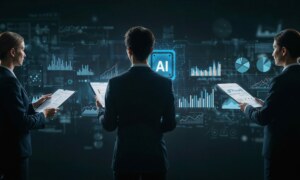


Artificial intelligence is no longer a distant promise whispered in research labs or portrayed as futuristic fantasy in movies. It has quietly moved into the background of everyday life powering the tools we use, shaping the decisions businesses make, and influencing how societies solve complex problems. The conversation has shifted from what AI might become to what AI is already doing.
This transition from hype to reality marks one of the most significant technological turning points of our time. Instead of abstract possibilities, we are witnessing practical, measurable change across healthcare, education, finance, creative industries, and public services. Understanding these real-world transformations helps us move beyond fear or fascination and toward meaningful participation in an AI-enabled future.
The Shift From Buzzword to Backbone
Only a few years ago, AI discussions were dominated by speculation job loss predictions, superintelligent machines, or dramatic breakthroughs that seemed perpetually “five years away.” Today, the narrative is more grounded. AI is becoming infrastructure rather than spectacle.
Just as electricity transformed industries without constant attention, AI is embedding itself into workflows, quietly improving efficiency and insight. Many people already rely on AI daily without labeling it as such through navigation apps that predict traffic, recommendation systems that personalize content, or smart assistants that streamline routine tasks.
The true transformation is not flashy automation but practical augmentation. AI is helping humans make better decisions, faster and with more context.
Healthcare: Earlier Detection, Better Outcomes
Perhaps the most meaningful real-world impact of AI is unfolding in healthcare. Instead of replacing doctors, AI is strengthening clinical judgment and expanding access to care.
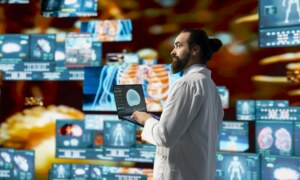
Machine learning systems can now analyze medical images such as X-rays, CT scans, and retinal photographs with remarkable accuracy. In many cases, these systems identify early signs of disease that are difficult for the human eye to detect. Earlier diagnosis leads to earlier treatment, which can dramatically improve survival rates and quality of life.
AI is also transforming preventive care. Predictive models analyze patient histories, lifestyle factors, and genetic information to estimate future health risks. This enables healthcare providers to intervene before illness becomes severe, shifting medicine from reactive treatment to proactive wellness.
Equally important is accessibility. AI-powered chat tools and remote monitoring systems are expanding healthcare support to rural and underserved communities, helping bridge long-standing equity gaps. When implemented responsibly, these technologies do not replace human compassion they extend it.
Education: Personalized Learning at Scale
Education systems around the world have long struggled with a core challenge: every learner is different, but classrooms often move at a single pace. AI is beginning to change this dynamic.
Adaptive learning platforms analyze how students interact with lessons where they hesitate, what they master quickly, and which explanations resonate most. The system then adjusts difficulty levels, provides targeted practice, and offers alternative explanations. This creates a learning experience that feels more like one-to-one tutoring than standardized instruction.
Teachers also benefit. AI can automate administrative tasks such as grading objective assessments, tracking progress, and generating feedback summaries. With routine work reduced, educators gain more time for mentorship, creativity, and emotional support the uniquely human elements of teaching that technology cannot replicate.
Most importantly, inclusive design in AI-driven education tools is helping support learners with disabilities through speech-to-text, real-time translation, and personalized accessibility features. When thoughtfully applied, AI becomes a force for educational equity rather than division.
Work and Business: Augmentation, Not Just Automation
Public anxiety around AI often centers on job displacement. While automation is real, the broader trend is more nuanced. Many roles are not disappearing; they are evolving.
AI excels at pattern recognition, data processing, and repetitive analysis. Humans excel at judgment, empathy, creativity, and complex decision-making. When combined, productivity increases without eliminating the human role.
In customer service, AI assistants handle routine inquiries instantly, allowing human agents to focus on complex or emotionally sensitive cases. In finance, AI detects fraud patterns within seconds, protecting both institutions and individuals. In manufacturing, predictive maintenance systems anticipate equipment failures before they occur, reducing downtime and improving worker safety.
New categories of employment are also emerging AI trainers, ethics specialists, data curators, and human-AI interaction designers. History shows that technological shifts rarely eliminate work entirely; instead, they redefine what meaningful work looks like.
Creativity: Collaboration Between Human and Machine
One of the most surprising real-world transformations is happening in creative fields once thought immune to automation. Writers, designers, musicians, and filmmakers are now experimenting with AI as a collaborative partner.
Rather than replacing creativity, AI can accelerate the early stages of ideation suggesting concepts, generating drafts, or exploring visual variations. Creators remain the decision-makers, curators, and storytellers who shape raw output into meaningful expression.
This shift is similar to the introduction of digital editing tools or photography software. At first, new tools raise concern; eventually, they expand artistic possibility. The key question is no longer whether AI can create, but how humans choose to create with it.
Ethical considerations such as attribution, consent, and fair compensation remain essential. Responsible creative ecosystems must ensure that technological progress supports, rather than exploits, human talent.
Public Services and Smart Governance
Governments and public institutions are beginning to apply AI to improve service delivery and resource allocation. Traffic optimization systems reduce congestion and emissions. Disaster prediction models support faster emergency response. Data-driven welfare programs help ensure that support reaches the people who need it most.
When transparency and accountability are prioritized, AI can strengthen public trust by making systems more responsive and evidence-based. However, poorly governed AI can also reinforce bias or reduce privacy.
The difference lies not in the technology itself, but in how societies choose to design and regulate it.
Ethical Responsibility in the Real World
As AI moves from hype to daily reality, ethical questions become more urgent. Bias in training data can lead to unfair outcomes. Opaque decision-making can reduce accountability. Excessive surveillance can threaten civil liberties.
Responsible AI requires intentional design diverse datasets, transparent models, human oversight, and clear governance frameworks. Inclusion must be built into systems from the beginning, not added later as an afterthought.
Equally important is digital literacy. People deserve to understand when AI is influencing decisions that affect their lives. Empowered users are essential for ethical technology ecosystems.
Human Skills in an AI-Enabled Future
Ironically, the rise of intelligent machines is increasing the value of distinctly human abilities. Critical thinking, empathy, communication, and ethical reasoning are becoming core professional skills rather than optional traits.
Education and workforce development must evolve accordingly. Instead of competing with AI in speed or memorization, people will thrive by doing what machines cannot connecting ideas across disciplines, understanding social context, and making values-based decisions.
The future of work is not human versus AI. It is human with AI.
Looking Ahead: Realism Over Hype
The most important lesson from today’s AI transformation is that meaningful change rarely arrives as a dramatic moment. Instead, it unfolds gradually through improved diagnoses, smoother learning experiences, safer infrastructure, and more informed decisions.
This realism is encouraging. It suggests that society still has agency. Policies, education systems, and ethical standards can shape how AI develops. The future is not predetermined by algorithms; it is guided by human choices.
Conclusion: A Technology That Reflects Us
AI’s journey from hype to reality reveals something deeper than technological progress. It reflects human priorities—our desire for health, knowledge, creativity, fairness, and connection.
When designed with care and inclusivity, AI can expand opportunity and reduce inequality. When guided poorly, it can magnify existing problems. The outcome depends not on machines, but on us.
Rather than asking whether AI will change the world, a more meaningful question emerges:
How will we choose to change the world with AI already in our hands?
The answer is being written now in hospitals, classrooms, workplaces, studios, and communities everywhere. And for the first time, the future of artificial intelligence feels less like science fiction and more like shared responsibility.