

Sign Up

Sign Up to our social questions and Answers Engine to ask questions, answer people’s questions, and connect with other people.

Have an account? Sign In


Have an account? Sign In Now

Sign In

Login to our social questions & Answers Engine to ask questions answer people’s questions & connect with other people.

Sign Up Here


Forgot Password?

Don't have account, Sign Up Here

Forgot Password

Lost your password? Please enter your email address. You will receive a link and will create a new password via email.


Have an account? Sign In Now

You must login to ask a question.


Forgot Password?

Need An Account, Sign Up Here

You must login to add post.


Forgot Password?

Need An Account, Sign Up Here
Sign InSign Up

Qaskme

Qaskme Logo Qaskme Logo

Qaskme Navigation

  • Home
  • Questions Feed
  • Communities
  • Blog
Search
Ask A Question

Mobile menu

Close
Ask A Question
  • Home
  • Questions Feed
  • Communities
  • Blog
Home/Questions/Page 49

Qaskme Latest Questions

daniyasiddiquiEditor’s Choice
Asked: 15/08/2025In: Company, News, Technology

How will global AI regulations impact open-source model development?


aitechnology
  1. daniyasiddiqui
    daniyasiddiqui Editor’s Choice
    Added an answer on 15/08/2025 at 3:53 pm

    Global AI Rules & Open-Source: The Balancing Act Open-source AI has been the engine of creativity in the AI world—anyone with the skills and curiosity can take a model, improve it, and build something new. But as governments race to set rules for safety, privacy, and accountability, open-sourceRead more

    Global AI Rules & Open-Source: The Balancing Act

    Open-source AI has been the engine of creativity in the AI world—anyone with the skills and curiosity can take a model, improve it, and build something new. But as governments race to set rules for safety, privacy, and accountability, open-source developers are entering a trickier landscape.

    Stricter regulations could mean:

    More compliance hurdles – small developers might need to meet the same safety or transparency checks as tech giants.

    Limits on model release

    some high-risk models might only be shared with approved organizations.

    Slower experimentation

    extra red tape could dampen the rapid, trial-and-error pace that open-source thrives on.

    On the flip side, these rules could also boost trust in open-source AI by ensuring models are safer, better documented, and less prone to misuse.

    In short

    global AI regulation could be like adding speed limits to a racetrack—it might slow the fastest laps, but it could also make the race safer and more inclusive for everyone.

    See less
      • 0
    • Share
      Share
      • Share on Facebook
      • Share on Twitter
      • Share on LinkedIn
      • Share on WhatsApp
  • 7
  • 1
  • 265
  • 0
Answer
Anonymous
Asked: 15/08/2025In: Communication, News, Technology

What role will neurosymbolic AI play in the next wave of innovation?

the next wave of innovation

newstechnology
  1. Anonymous
    Anonymous
    Added an answer on 15/08/2025 at 3:06 pm

    Neurosymbolic AI: Merging Intelligence with Logic Think of neurosymbolic AI as the combination of two types of intelligence. Here you have neural networks. They provide powerful pattern recognition for messy, unstructured data from the real world including image, voice, and sensor data. Here you havRead more

    Neurosymbolic AI: Merging Intelligence with Logic

    Think of neurosymbolic AI as the combination of two types of intelligence. Here you have neural networks. They provide powerful pattern recognition for messy, unstructured data from the real world including image, voice, and sensor data. Here you have symbolic reasoning, a powerful way to apply rules, logic, and structured knowledge to formal problem solving.

    How may we combine both of these approaches? Each approach is great on its own. Today’s AI can very well detect a cat in an image and very well solve a logic puzzle, but it cannot do both together. Neurosymbolic AI makes this possible. It can:

    1. Reason and explain its decisions—not just give answers but explain why those answers are valid

    2. Learn quickly—as it encounters new patterns, it can not only rely on the new knowledge but also relate what it has already learned, instead of having to start with zero application and comprehension.

    3. Recognize and account for uncertainty better. Neurosymbolic AI can apply logic when data is articulated clearly, and learn when it is messy.

    In the next technological wave, we may see AI reading complex legal contracts, teasing out the author’s intent, and reasoning toward implications. Or we may see medical AI that integrates lab tests and established care guidelines toward timely and safe diagnoses.

    Neurosymbolic AI provides an AI with something resembling an “intuition”

    See less
      • 0
    • Share
      Share
      • Share on Facebook
      • Share on Twitter
      • Share on LinkedIn
      • Share on WhatsApp
  • 6
  • 1
  • 250
  • 0
Answer
Anonymous
Asked: 14/08/2025In: Communication, News, Technology

How are global supply chains adapting to new tariff policies?

new tariff policies

aitechnology
  1. Anonymous
    Anonymous
    Added an answer on 14/08/2025 at 4:15 pm

    International supply chains are adapting to be more agile than ever to the latest tariff regimes — pretty much like an old traveler forced to shift flight paths halfway through the journey. This is what's going down on the ground: Rebasing trade routes – Businesses are redirecting sourcing from natiRead more

    International supply chains are adapting to be more agile than ever to the latest tariff regimes — pretty much like an old traveler forced to shift flight paths halfway through the journey.

    This is what’s going down on the ground:

    Rebasing trade routes – Businesses are redirecting sourcing from nations impacted with increased tariffs to nations with more amicable terms of trade. For instance, a company that previously depended on China would now diversify vendors in Vietnam, Mexico, or Eastern Europe.

    “Friendshoring” and regional hubs – Rather than a single massive manufacturing hub, supply chains are fragmenting into regional webs to manage risk. In this manner, if one trade lane becomes pricey or clogged, the others continue going.

    Tech-powered forecasting – AI and analytics are enabling firms to model “what if” tariff situations so they can reconfigure orders, shipping routes, and pricing before issues arise.

    Revival of local production – Increased tariffs make imports more expensive, so some businesses are taking some production steps in-house — creating local employment but also redefining cost profiles.

    Why it feels so human:

    Companies aren’t merely juggling figures; they’re being flexible and ingenious. Just as individuals learn to live with unexpected shifts in their own household budgets, companies are getting better at making shrewder trade-offs — safeguarding what’s most important while leveraging innovation to stay alive.

    Briefly put, tariffs are making supply chains more like nimble gymnasts than rigid production lines — agile, diversified, and able to roll with the punches.

    See less
      • 1
    • Share
      Share
      • Share on Facebook
      • Share on Twitter
      • Share on LinkedIn
      • Share on WhatsApp
  • 5
  • 1
  • 274
  • 0
Answer
Anonymous
Asked: 14/08/2025In: Communication, News, Technology

How are global supply chains adapting to new tariff policies?

new tariff policies

aitechnology
  • 4
  • 0
  • 258
  • 0
Answer
Anonymous
Asked: 14/08/2025In: Communication, Technology

Are “AI twins” becoming the next big thing in personalized experiences?

personalized experiences

aitechnolgy
  1. Anonymous
    Anonymous
    Added an answer on 14/08/2025 at 3:05 pm

    Yes "AI twins" are fast becoming one of the most thrilling frontiers in bespoke experiences, and here's why it already seems so futuristic but oddly natural. Picture a virtual you not a mere profile with your information, but a developing, learning AI that knows your tastes, recalls your idiosyncrasRead more

    Yes

    “AI twins” are fast becoming one of the most thrilling frontiers in bespoke experiences, and here’s why it already seems so futuristic but oddly natural.

    Picture a virtual you

    not a mere profile with your information, but a developing, learning AI that knows your tastes, recalls your idiosyncrasies, adjusts to your moods, and can execute on your behalf. It’s having an endless personal assistant, life guide, and social ambassador all in one, except that it dwells in your phone or in the cloud.

    Why everyone is abuzz about it:

    Ultra-personalized recommendations – Your AI twin is able to recommend what to watch, read, or eat, not according to broad trends but according to your actual history and present mood.

    Decision-making help

    It is able to simulate scenarios for you (“What if I relocate to another city?”) and provide data-driven, emotionally intelligent advice.

    Life administration

    It may organize your appointments, write your emails, or negotiate with other AI twins (yes, your AI could one day arrange a holiday with your friend’s AI without either of you lifting a finger on your phones).

    The people side of the thrill

    Individuals are fond of the concept since it guarantees less overload in an information-rich world. It’s sort of outsourcing your mental mess to a “you, but on autopilot” — without sacrificing the human touch.

    The flip side

    Of course, this also raises significant concerns about privacy, security, and who really “owns” your twin’s knowledge about you. I mean, a digital you might be more revealing than your actual you.

    in Short

    AI twins are looking to be the next big thing in personalization. If the 2010s were the decade of the recommendation engine and the 2020s are going to be the decade of AI assistants, then the next decade might be AI versions of us living alongside us in everyday life.

    See less
      • 0
    • Share
      Share
      • Share on Facebook
      • Share on Twitter
      • Share on LinkedIn
      • Share on WhatsApp
  • 5
  • 1
  • 205
  • 0
Answer
daniyasiddiquiEditor’s Choice
Asked: 13/08/2025In: Communication, News, Technology

How are governments balancing AI innovation with data privacy protection?


ainews
  1. daniyasiddiqui
    Best Answer
    daniyasiddiqui Editor’s Choice
    Added an answer on 13/08/2025 at 4:37 pm

    Governments today are teetering on a tightrope — and it's not a comfortable one. On one hand, there is AI innovation, which holds the promise of quicker healthcare diagnoses, more intelligent public services, and even economic expansion through industries powered by technology. On the other hand, thRead more

    Governments today are teetering on a tightrope — and it’s not a comfortable one.

    On one hand, there is AI innovation, which holds the promise of quicker healthcare diagnoses, more intelligent public services, and even economic expansion through industries powered by technology. On the other hand, there is data privacy, where the stakes are intensely personal: individuals’ medical records, financial information, and private discussions.

    The catch? AI loves data — the more, the merrier — but privacy legislation is meant to cap how much of it can be harvested, stored, or transmitted. Governments are thus attempting to find a middle ground by:

    Establishing clear limits using regulations such as GDPR in Europe or new AI-specific legislation that prescribes what is open season for data harvesting.

    Spurring “privacy-first” AI — algorithms that can be trained on encrypted or anonymized information, so personal information never gets shared.

    Experimenting sandbox spaces, where firms can try out AI in controlled, overseen environments before the public eye.

    It’s a little like having children play at a pool — the government wants the enjoyment and skill development to occur, but they’re having lifeguards (regulators) on hand at all times.

    If they move too far in the direction of innovation, individuals will lose faith and draw back from cooperating and sharing information; if they move too far in the direction of privacy, AI development could grind to a halt. The optimal position is somewhere in between, and each nation is still working on where that is.

    See less
      • 1
    • Share
      Share
      • Share on Facebook
      • Share on Twitter
      • Share on LinkedIn
      • Share on WhatsApp
  • 7
  • 1
  • 257
  • 0
Answer
daniyasiddiquiEditor’s Choice
Asked: 13/08/2025In: Company, News, Technology

what is a tariff ?

A tariff

newstechnology
  1. daniyasiddiqui
    Best Answer
    daniyasiddiqui Editor’s Choice
    Added an answer on 13/08/2025 at 4:05 pm

    A tariff is basically a tax that a government charges on goods coming into or going out of a country. Think of it like an entry fee at a theme park — if a product wants to “enter” a country, the government might ask for a payment at the border. Governments do this for a few reasons: to protect localRead more

    A tariff is basically a tax that a government charges on goods coming into or going out of a country.

    Think of it like an entry fee at a theme park — if a product wants to “enter” a country, the government might ask for a payment at the border. Governments do this for a few reasons: to protect local businesses from cheaper foreign products, to encourage people to buy locally made goods, or to raise money for national projects.

    For example, if imported shoes have a tariff, they become more expensive in stores. That way, local shoe makers might have a better chance to compete.

    It’s not always good or bad — tariffs can protect jobs, but they can also make everyday items more expensive.

    See less
      • 2
    • Share
      Share
      • Share on Facebook
      • Share on Twitter
      • Share on LinkedIn
      • Share on WhatsApp
  • 7
  • 1
  • 267
  • 0
Answer
Anonymous
Asked: 13/08/2025In: Health, News

Which foods naturally boost immunity?

naturally immunity boost foods

heathpeople
  1. Anonymous
    Anonymous
    Added an answer on 13/08/2025 at 3:13 pm

    Your immune system is like your body’s security team — and just like any team, it works best when it’s well-fed and well-trained. While no single food is a magic “immunity shield,” certain nutrients can help your body fight off germs more effectively and recover faster. Foods That Give Your Immune SRead more

    Your immune system is like your body’s security team — and just like any team, it works best when it’s well-fed and well-trained. While no single food is a magic “immunity shield,” certain nutrients can help your body fight off germs more effectively and recover faster.

    • Foods That Give Your Immune System a Natural Lift

    Citrus Fruits (oranges, lemons, grapefruits)

    • Packed with vitamin C, which supports white blood cells — your body’s infection fighters.

    Berries (blueberries, strawberries, blackberries)

    • Rich in antioxidants that protect your cells from damage and keep inflammation in check.

    Leafy Greens (spinach, kale, mustard greens)

    • Loaded with vitamins A, C, and K, plus folate — all important for immune cell function.

    Garlic & Onions

    • Contain compounds like allicin that have natural antibacterial and antiviral properties.

    Nuts & Seeds (almonds, sunflower seeds, pumpkin seeds)

    • Great sources of vitamin E and zinc, which help regulate and strengthen immune responses.

    Yogurt & Fermented Foods (kefir, kimchi, sauerkraut)

    • Provide probiotics that support gut health — and a healthy gut means a stronger immune system.

    Fatty Fish (salmon, mackerel, sardines)

    • Rich in omega-3 fatty acids that reduce chronic inflammation, helping your immune cells work better.

    Ginger & Turmeric

    Both have anti-inflammatory and antioxidant effects that can help keep immune defenses strong.

     Bottom line:

    Think variety, not just one “superfood.” A colorful plate with fruits, veggies, lean proteins, and healthy fats will do more for your immunity than any single ingredient or supplement.

    See less
      • 0
    • Share
      Share
      • Share on Facebook
      • Share on Twitter
      • Share on LinkedIn
      • Share on WhatsApp
  • 5
  • 1
  • 215
  • 0
Answer
Anonymous
Asked: 13/08/2025In: Health, News

What vaccines are recommended for adults?

What vaccines are recommended for adu ...

healthpeople
  1. daniyasiddiqui
    daniyasiddiqui Editor’s Choice
    Added an answer on 13/08/2025 at 2:51 pm

    The defenses we have against those illnesses that can hit harder. Vaccines aren't just for kids — grown-ups need them too, both to keep up with age. Think of them as just regular "software updates" to your immune system. Routine Vaccines Most Grown-Ups Need: Flu Shot (once a year) Protects against fRead more

    The defenses we have against those illnesses that can hit harder. Vaccines aren’t just for kids — grown-ups need them too, both to keep up with age. Think of them as just regular “software updates” to your immune system.

    Routine Vaccines Most Grown-Ups Need:

    Flu Shot (once a year)

    Protects against flu season, which can be more lethal in adults than we know. Should get before flu season peaks.

    COVID-19 Vaccine & Boosters

    Protects against serious illness and maintains up-to-date immunity as variants change.

    Tdap or Td (Tetanus, Diphtheria, Pertussis)

    A single dose of Tdap as an adult (if you never had it), with a Td or Tdap booster every 10 years.

    Indirectly helps protect infants as well if you are around babies (who cannot yet receive pertussis protection).

    Shingles (Herpes Zoster)

    Recommended for all people 50 years and older (two-dose series). Shingles can be painful and last, so this one’s worth it.

    Pneumococcal Vaccines

    Recommended for those 65 and older and younger adults with some medical conditions (e.g., diabetes or heart disease). Stops pneumonia, meningitis, and blood infections.

    HPV Vaccine

    If you did not get it as a teen, it is recommended up to age 26 (sometimes through age 45 based on risk). Stems certain cancers.

    Other Vaccines Depending on Your Life & Travel:

    Hepatitis A & B:

    If you work in healthcare, travel often, or have a lifestyle risk.

    Meningococcal :

    If you’re traveling to certain countries or are at increased risk.

    Travel-specific vaccines :

    Yellow fever or typhoid in particular countries.

     Bottom line:

    The “right” vaccines depend on your age, health, job, and travel plans. It takes just a few minutes to talk to your doctor or pharmacist to make sure your immunity is up to date — no guessing necessary.”.

    See less
      • 0
    • Share
      Share
      • Share on Facebook
      • Share on Twitter
      • Share on LinkedIn
      • Share on WhatsApp
  • 5
  • 1
  • 238
  • 0
Answer
Anonymous
Asked: 13/08/2025In: Programmers

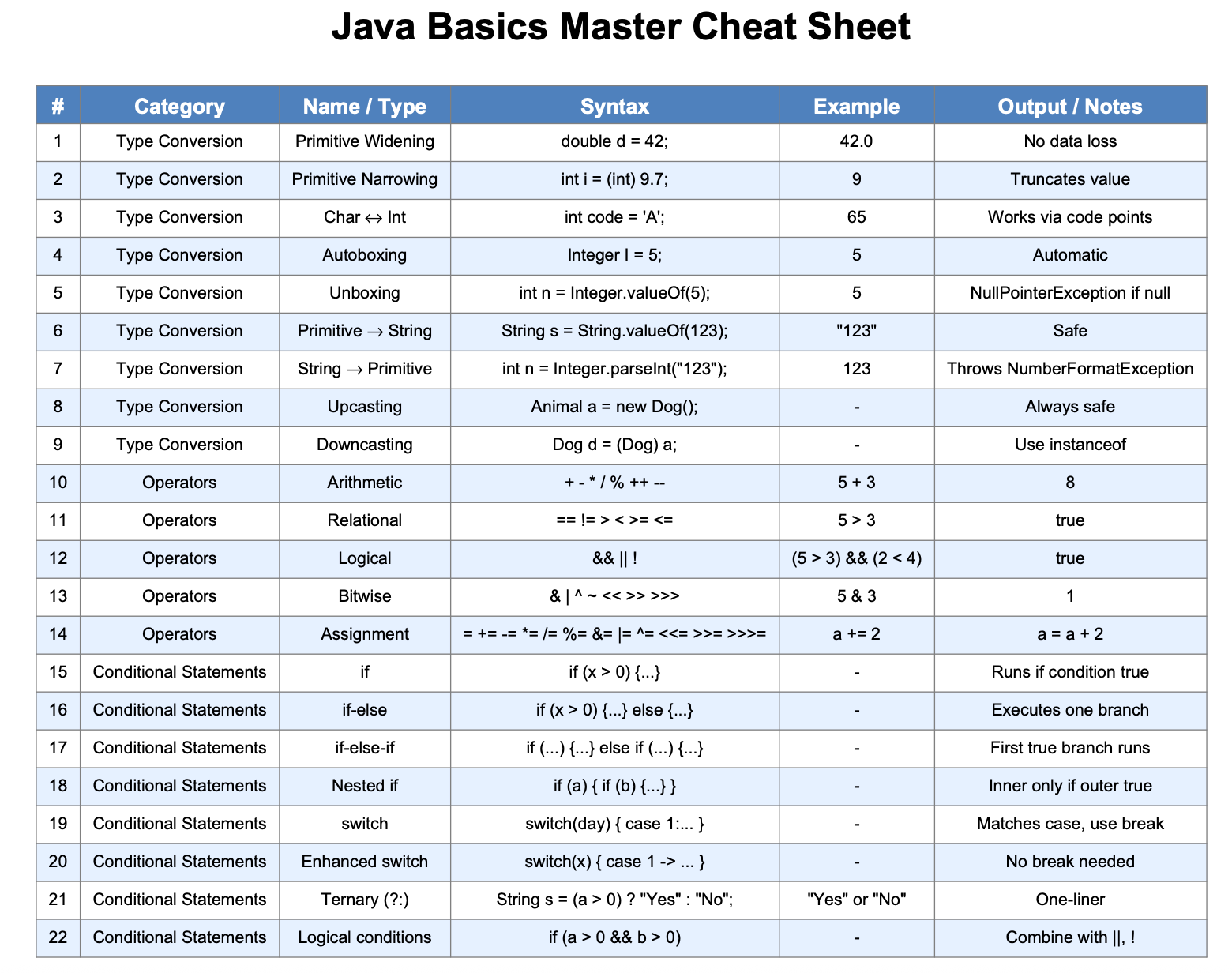
Please share Java Basics Master Cheat Sheet

Java Basics Master Cheat Sheet

javaprogramming
  1. Anonymous
    Anonymous
    Added an answer on 13/08/2025 at 8:29 am
    Please share Java Basics Master Cheat Sheet

    I have attached a screenshot of the master cheat sheet.

    I have attached a screenshot of the master cheat sheet.

    See less
      • 1
    • Share
      Share
      • Share on Facebook
      • Share on Twitter
      • Share on LinkedIn
      • Share on WhatsApp
  • 4
  • 1
  • 256
  • 0
Answer
Load More Questions

Sidebar

Ask A Question

Stats

  • Questions 548
  • Answers 1k
  • Posts 28
  • Best Answers 21
  • Popular
  • Answers
  • mohdanas

    Are AI video generat

    • 940 Answers
  • daniyasiddiqui

    How is prompt engine

    • 187 Answers
  • daniyasiddiqui

    “What lifestyle habi

    • 58 Answers
  • Henrygom
    Henrygom added an answer Курсы ЕГЭ по истории https://courses-ege.ru 06/02/2026 at 3:12 am
  • Henrygom
    Henrygom added an answer Слив курсов ЕГЭ история https://courses-ege.ru 06/02/2026 at 2:38 am
  • Elektrokarniz_woKl
    Elektrokarniz_woKl added an answer электрокарниз купить в москве [url=https://prokarniz38.ru/]электрокарниз купить в москве[/url] . 06/02/2026 at 1:10 am

Top Members

Trending Tags

ai aiineducation ai in education analytics artificialintelligence artificial intelligence company deep learning digital health edtech education health investing machine learning machinelearning news people tariffs technology trade policy

Explore

  • Home
  • Add group
  • Groups page
  • Communities
  • Questions
    • New Questions
    • Trending Questions
    • Must read Questions
    • Hot Questions
  • Polls
  • Tags
  • Badges
  • Users
  • Help

© 2025 Qaskme. All Rights Reserved