
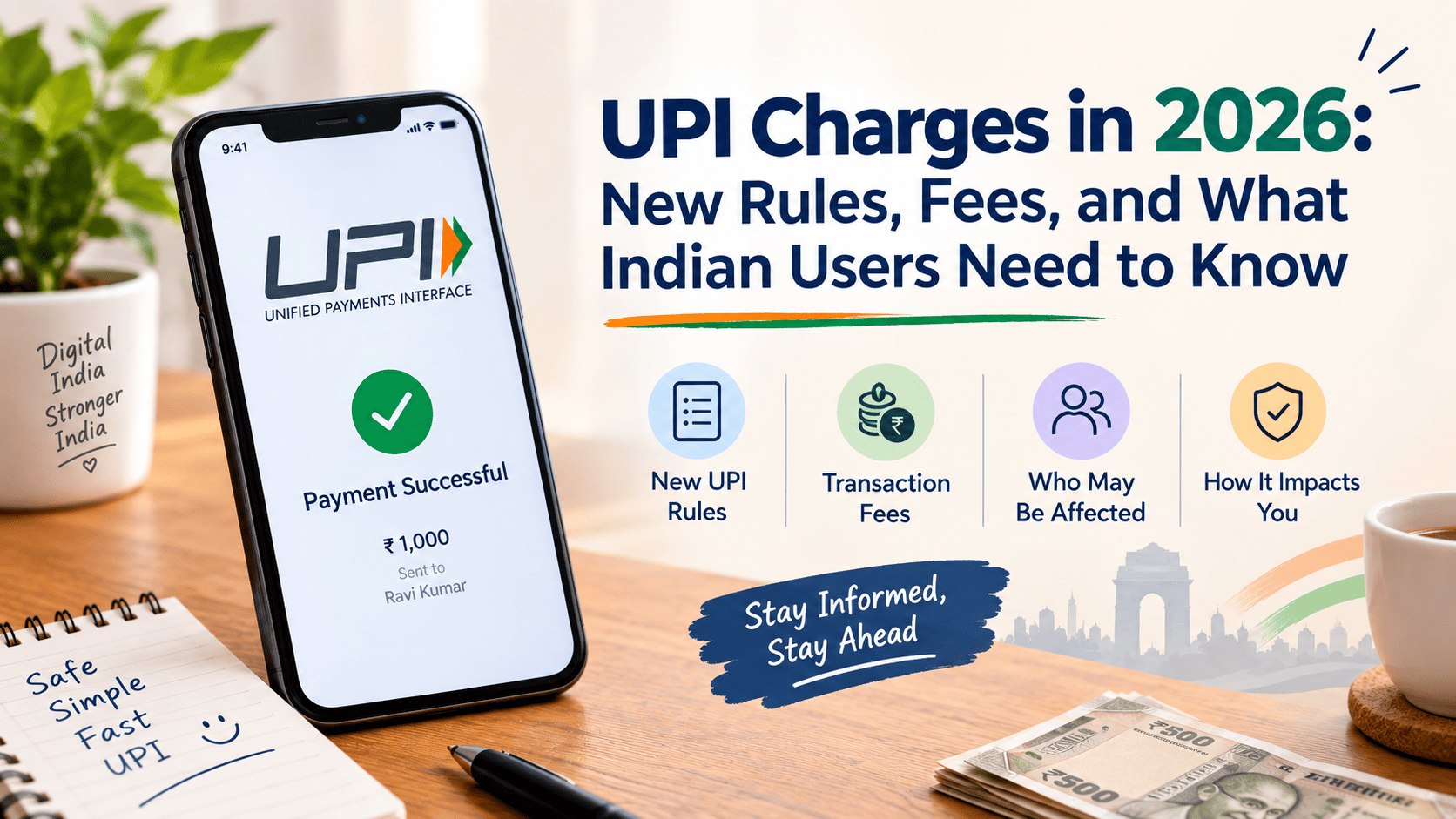
If you use UPI regularly, you may have already heard about the UPI New Rules 2026. UPI has become one of the easiest ways to pay for groceries, food, shopping, bills, travel, and other everyday expenses. Now that new payment rules are being introduced, many people are wondering whether they will have to pay extra when using UPI.
The good news is that the new rules do not mean every UPI payment will suddenly become chargeable. The changes mainly concern certain payments made to merchants, while person-to-person transfers continue to remain free.
So, what exactly has changed? Let’s look at the new rules, the 0.4% MDR, who is affected, and what regular UPI users need to know.
What Are the UPI New Rules 2026?
Under the UPI New Rules 2026, a 0.4% Merchant Discount Rate (MDR) will apply to specified person-to-merchant UPI transactions above ₹2,000 from October 15, 2026. The MDR is a charge within the payment ecosystem and is mainly associated with the merchant side of the transaction.
For example, if an eligible merchant receives a UPI payment of ₹5,000, 0.4% of that amount is ₹20. However, this does not mean that the customer will automatically be asked to pay ₹5,020.
The government has clarified that customers will not directly pay the MDR. The charge is distributed among participants in the payment ecosystem, including banks and payment service providers.
Will Every UPI Payment Have a New Charge?
No. This is one of the most important things to understand about the UPI New Rules 2026.
There are two common types of UPI payments. A person-to-person (P2P) payment is when you send money directly to another person. A person-to-merchant (P2M) payment is when you pay a shop, restaurant, company, or another business.
Person-to-person transactions will remain free regardless of the amount. Merchant payments up to ₹2,000 will also remain outside the MDR framework.
Sending Money to Friends or Family
Suppose your friend asks you to send ₹1,000. You open your UPI app, enter their UPI ID, and complete the payment.
That is a person-to-person transaction, so the new merchant MDR does not apply.
Even if you send more than ₹2,000 to a friend or family member, the P2P transaction remains free under the new framework.
Paying a Shop or Business
Now imagine that you visit a store and purchase something worth ₹5,000. You scan the merchant’s QR code and pay through UPI.
This is a person-to-merchant payment. If it falls under the specified categories and crosses ₹2,000, the new MDR can apply from October 15, 2026.
So, saying “every UPI payment above ₹2,000 will have a customer fee” would be misleading. The type of payment matters.
How Much Is 0.4% on a UPI Payment?
The 0.4% figure may sound confusing at first, but the calculation is simple.
| Payment amount | 0.4% MDR |
|---|---|
| ₹2,500 | ₹10 |
| ₹5,000 | ₹20 |
| ₹10,000 | ₹40 |
| ₹25,000 | ₹100 |
| ₹50,000 | ₹200 |
| ₹75,000 | ₹300 |
For transactions of ₹75,000 and above, the MDR is capped at ₹300 per transaction.
These figures show the MDR calculation. They should not be understood as an extra amount that every customer will automatically have to pay.
https://www.qaskme.com/online-scams-in-2026-how-to-protect-yourself-from-digital-fraud/
Will Customers Have to Pay the New UPI Fee?
This is probably the biggest concern for people hearing about the UPI New Rules 2026.
The MDR is a charge within the merchant payment ecosystem. The government has specifically clarified that consumers will not directly pay this MDR.
So, if you buy something for ₹5,000 from a merchant covered by the new framework, you should not automatically assume that you will be charged ₹5,020.
It is still a good habit to check the amount and the recipient’s name before entering your UPI PIN. That can help you avoid simple payment mistakes.
Why Are These UPI Rules Changing?
UPI has grown enormously over the past few years. Millions of people use it every day for small purchases, online shopping, bills, travel, and money transfers.
NPCI’s official statistics show that UPI processed 24,508.96 million transactions in August 2026, which is about 24.5 billion transactions in one month. The total transaction value was around ₹29.82 lakh crore.
A payment network operating at this scale needs technology infrastructure, security systems, fraud monitoring, banks, payment providers, and customer support.
The revised MDR framework is intended to support the payment ecosystem while keeping person-to-person payments and most everyday low-value merchant transactions free. The government says approximately 96% of P2M transactions will remain unaffected.
What About Small Shops?
Small businesses are an important part of India’s UPI ecosystem. Local grocery stores, restaurants, medical shops, clothing stores, and many other businesses accept payments through QR codes.
The new framework also provides a zero-MDR arrangement for eligible small merchants, subject to the applicable conditions. This means smaller businesses may not be treated in the same way as larger merchants handling high volumes of UPI payments.
For merchants, their business category and the amount of UPI payments they receive can therefore make a difference.
Are There Different UPI Charges for Some Transactions?
Yes. The 0.4% rate is not the only rate under the new framework.
For certain essential and thin-margin sectors, including railways, telecommunications, insurance, fuel, and agricultural inputs, payments above ₹2,000 will attract a flat MDR of ₹5 per transaction. Capital-market-related payments have a separate 0.02% MDR, capped at ₹300 per transaction.
This means users should not assume that one single fee applies to every large UPI payment.
https://www.npci.org.in/product/upi?utm_source=chatgpt.com
What Do the UPI New Rules 2026 Mean for Everyday Users?
For people who mainly use UPI for everyday spending, the change may not affect most of their payments.
Think about a normal day. You might pay ₹200 for breakfast, ₹600 for groceries, ₹800 for dinner, or ₹1,500 for a household purchase. Merchant payments up to ₹2,000 remain outside the new MDR framework.
If you send money to a friend or family member, that person-to-person transfer also remains free.
The main change concerns specified merchant transactions above ₹2,000. Even then, the MDR is not the same thing as a fee that customers are automatically asked to pay.
Be Careful of Fake UPI Fee Messages
Whenever a new banking rule is announced, scammers may try to take advantage of the confusion.
You could receive a message claiming that your UPI account will be blocked unless you pay a fee. Someone may also ask for your UPI PIN, OTP, password, or banking details.
Do not share these details.
If you receive a message about a new UPI fee, check the information through your bank, UPI app, NPCI, or another official source. Never trust an unknown link simply because the message says that your UPI account is at risk.
What Should You Check Before Making a UPI Payment?
You do not need to stop using UPI because of the new rules. A few simple habits can help you make safer payments.
First, check the name of the person or business shown on the payment screen. Make sure it matches the person or shop you want to pay.
Next, check the amount carefully. A typing mistake can turn a ₹500 payment into ₹5,000.
Most importantly, keep your UPI PIN private. Enter it yourself when authorising a payment and never share it with another person.
Is UPI Still Useful in 2026?
The UPI New Rules 2026 change how certain merchant payments are processed, but they do not mean that UPI is becoming a paid service for everyone.
UPI continues to handle billions of transactions every month. NPCI’s August 2026 data shows just how widely the payment system is being used across India.
For everyday users, the most useful thing is to understand the difference between person-to-person transfers and merchant payments. Once you know that difference, the new rules become much easier to understand.
Frequently Asked Questions
Are UPI payments free in 2026?
Person-to-person UPI transfers remain free. Merchant payments up to ₹2,000 also remain outside the new MDR framework. Certain specified merchant transactions above ₹2,000 will be subject to MDR from October 15, 2026.
Will I have to pay when sending money to a friend?
No. Person-to-person UPI transactions remain free regardless of the amount transferred.
What is the new UPI charge above ₹2,000?
For specified person-to-merchant transactions above ₹2,000, the MDR is 0.4%. The charge is capped at ₹300 for transactions of ₹75,000 and above.
Will customers directly pay the MDR?
No. The government has clarified that customers will not directly pay the MDR. It is a charge within the merchant payment ecosystem.
Will small merchants be affected?
Eligible small merchants covered under the zero-MDR framework can remain exempt, subject to the applicable conditions.
When will the new UPI rules start?
The revised MDR framework is scheduled to come into effect on October 15, 2026.
Final Takeaway
The UPI New Rules 2026 do not mean that every UPI payment will suddenly become expensive.
From October 15, 2026, a 0.4% MDR will apply to specified merchant transactions above ₹2,000, while person-to-person transfers remain free. Payments up to ₹2,000 and eligible small-merchant transactions also remain outside the MDR framework.
For everyday users, there is no need to panic. Just check the amount before confirming a payment, keep your UPI PIN private, and be careful with messages asking you to pay a supposed UPI fee.