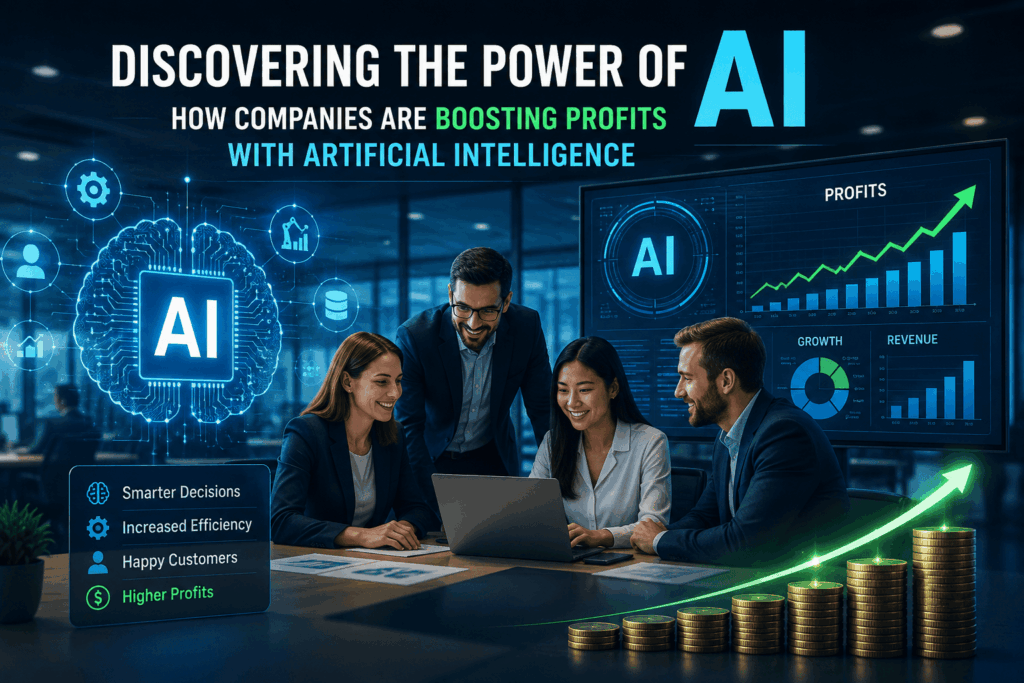
Artificial Intelligence (AI) is rapidly transforming the modern business landscape. Today, companies of all sizes from small startups to multinational corporations are boosting profits with Artificial Intelligence by leveraging data, automation, and intelligent systems. This shift is not just about technology; it’s about redefining how businesses operate, compete, and grow in a digital-first world.
In this extended guide, we’ll dive deeper into how organizations are using AI to increase efficiency, reduce costs, improve customer experiences, and unlock entirely new revenue streams.
Understanding the Role of AI in Modern Business
Before exploring strategies, it’s important to understand what AI actually does in a business context. Artificial Intelligence refers to machines or systems that can perform tasks typically requiring human intelligence, such as learning, reasoning, and problem-solving.
When companies focus on boosting profits with Artificial Intelligence, they are essentially using these smart systems to:
- Analyze large volumes of data
- Automate repetitive processes
- Predict future trends
- Personalize customer experiences
This combination creates a powerful engine for business growth.
Deep Dive: How Companies Are Boosting Profits with Artificial Intelligence
1. Intelligent Automation and Cost Reduction
Automation is one of the most immediate and impactful benefits of AI. Businesses are replacing time-consuming manual processes with AI-driven systems that work faster and more accurately.
For example:
- AI-powered chatbots handle customer queries 24/7
- Automated accounting systems reduce human error
- Supply chain automation improves efficiency
Tools like
👉 IBM Watson AI Solutions
help organizations automate workflows, leading to significant cost savings and higher profit margins.
2. Predictive Analytics: Turning Data into Profit
Predictive analytics is a game-changer for businesses. AI systems analyze historical data to forecast future outcomes, allowing companies to make proactive decisions.
For instance:
- Retailers predict demand to avoid overstocking
- Financial institutions assess risk more accurately
- Marketing teams forecast campaign performance
Platforms like
👉 Google Cloud AI
provide advanced analytics tools that help companies make smarter, data-driven decisions ultimately boosting profits.
3. Hyper-Personalization: Driving Customer Engagement
Modern consumers expect personalized experiences. AI enables businesses to deliver exactly that.
E-commerce platforms such as
👉 Amazon
use AI algorithms to recommend products based on user behavior, preferences, and purchase history. This level of personalization:
- Increases customer satisfaction
- Boosts conversion rates
- Encourages repeat purchases
As a result, companies see a direct increase in revenue.
4. AI-Powered Marketing Strategies
Marketing has evolved dramatically with the introduction of AI. Businesses are now using intelligent systems to optimize every aspect of their marketing efforts.
AI helps marketers:
- Identify the right audience
- Optimize ad spending
- Create targeted campaigns
- Analyze customer sentiment
Platforms like
👉 HubSpot Marketing AI Tools
allow businesses to automate marketing processes and improve ROI, making it easier to scale campaigns effectively.
5. Enhancing Customer Support with AI
Customer service plays a critical role in business success. AI is helping companies deliver faster, smarter, and more efficient support.
AI-driven solutions include:
- Chatbots for instant responses
- Virtual assistants for customer guidance
- Sentiment analysis for better understanding
These tools reduce response time and improve customer satisfaction, which directly contributes to higher retention rates and profits.
Industry-Specific Applications of AI
Retail Industry
Retailers are using AI to:
- Optimize inventory management
- Predict customer demand
- Personalize shopping experiences
This reduces waste and increases sales efficiency.
Finance Industry
In finance, AI is used for:
- Fraud detection
- Risk management
- Automated trading
These applications help minimize losses and maximize returns.
Healthcare Industry
Healthcare organizations use AI to:
- Improve diagnostics
- Reduce operational costs
- Enhance patient care
AI-driven insights lead to better outcomes and more efficient systems.
Manufacturing Industry
Manufacturers are leveraging AI for:
- Predictive maintenance
- Quality control
- Process optimization
This reduces downtime and increases productivity.
Advanced AI Technologies That Drive Profit Growth Machine Learning (ML)
Machine learning is the backbone of AI. It allows systems to learn from data and improve over time without being explicitly programmed.
Applications include:
- Recommendation engines
- Fraud detection
- Customer segmentation
Natural Language Processing (NLP)
NLP enables machines to understand and respond to human language. It powers:
- Chatbots
- Voice assistants
- Customer feedback analysis
Computer Vision
Computer vision allows machines to interpret images and videos. It is widely used in:
- Security systems
- Manufacturing quality checks
- Healthcare imaging
Robotic Process Automation (RPA)
RPA uses AI to automate repetitive tasks such as:
- Data entry
- Invoice processing
- Payroll management
This significantly reduces operational costs.
Measuring ROI: How AI Increases Profit Margins
Businesses investing in AI often see measurable returns in several ways:
- Reduced Costs: Automation lowers labor expenses
- Increased Revenue: Better targeting improves sales
- Improved Efficiency: Faster processes save time
- Enhanced Decision-Making: Data insights reduce risks
Companies using platforms like
👉 Microsoft AI Solutions
are able to track performance and continuously optimize their strategies.
AI and Competitive Advantage
In today’s competitive market, AI is not just an advantage it’s becoming a necessity. Companies that adopt AI early are able to:
- Innovate faster
- Respond to market changes quickly
- Offer better customer experiences
- Scale operations efficiently
Businesses that fail to adopt AI risk falling behind their competitors.
Ethical Considerations and Responsible AI Use
While AI offers many benefits, companies must also consider ethical implications. Responsible AI use involves:
- Protecting user data and privacy
- Ensuring transparency in AI decisions
- Avoiding bias in algorithms
- Maintaining human oversight
Balancing innovation with responsibility is key to sustainable growth.
Future Trends in Boosting Profits with Artificial Intelligence
The future of AI in business is incredibly exciting. Some emerging trends include:
- AI-driven decision intelligence
- Autonomous business operations
- Advanced predictive analytics
- AI-powered cybersecurity
As these technologies evolve, companies will find even more ways to increase profitability.
Conclusion: Why AI Is the Key to Future Profit Growth
Boosting profits with Artificial Intelligence is transforming how businesses operate across every industry. From automation and analytics to personalization and customer experience, AI is enabling companies to achieve unprecedented levels of efficiency and growth.
By leveraging tools from platforms like
👉 IBM Watson,
👉 Google Cloud AI, and
👉 Microsoft AI,
organizations can unlock new opportunities and stay ahead in a competitive market.
In the end, the companies that succeed will be those that embrace AI not just as a tool but as a strategic partner in growth.