
Choosing the correct income-tax return form often feels more confusing than calculating the tax itself. The difference between ITR-1 vs ITR-2 vs ITR-3 vs ITR-4 for AY 2026–27 does not depend only on whether you are salaried, self-employed or running a business. Your capital gains, rental income, freelance receipts, foreign assets and residential status can also affect the form you need to file.
For example, a salaried taxpayer who sold a few shares may have to move from ITR-1 to ITR-2. Someone with a full-time job and regular freelance income may need ITR-3 or ITR-4. Similarly, a small business owner cannot automatically select ITR-4 unless the presumptive taxation conditions are satisfied.
AY 2026–27 relates to income earned during Financial Year 2025–26, which ran from 1 April 2025 to 31 March 2026. Before selecting an ITR form, look at all your income sources—not just the one that contributes the largest amount.
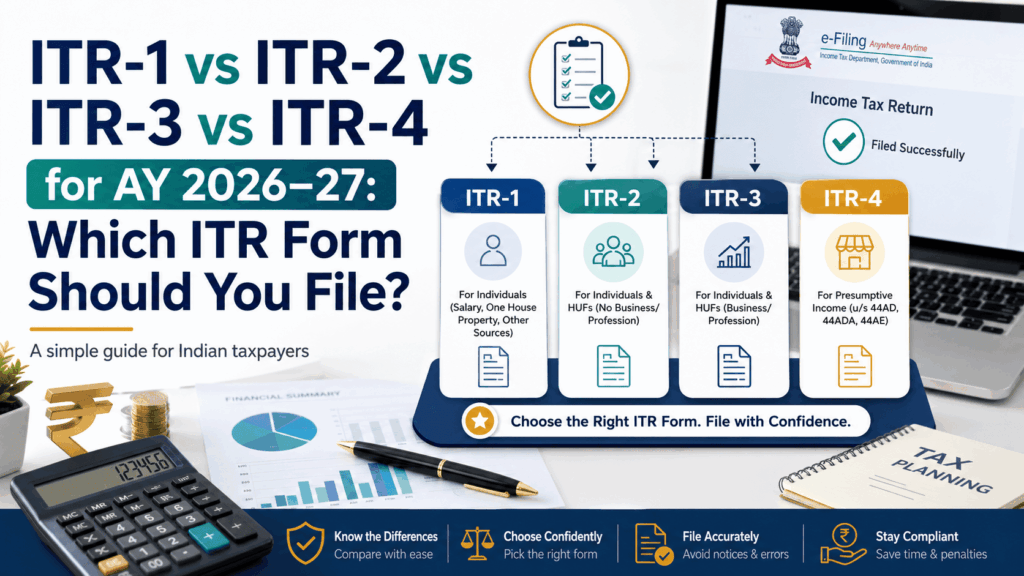
ITR-1 vs ITR-2 vs ITR-3 vs ITR-4 at a Glance
| ITR form | Generally suitable for | Main restriction |
|---|---|---|
| ITR-1 Sahaj | Resident individuals with relatively straightforward income | Total income generally cannot exceed ₹50 lakh |
| ITR-2 | Individuals and HUFs with capital gains or other complex income but no business income | Cannot be used when business or professional income is present |
| ITR-3 | Individuals and HUFs with business or professional income | More detailed financial reporting may be required |
| ITR-4 Sugam | Eligible residents using presumptive taxation | Total income cannot exceed ₹50 lakh, and several exclusions apply |
The easiest way to narrow down the choice is to start with one question:
Did you earn any income from a business, profession, consulting assignment or regular freelance activity?
When the answer is no, the choice is usually between ITR-1 and ITR-2. When the answer is yes, you generally need to consider ITR-3 or ITR-4.
Who Can File ITR-1 for AY 2026–27?
ITR-1, also known as Sahaj, is designed for resident individuals with comparatively simple income. It cannot be filed by a Hindu Undivided Family, partnership firm, company, non-resident or a person whose residential status is resident but not ordinarily resident.
You may be eligible for ITR-1 when your total income does not exceed ₹50 lakh and your income includes:
- Salary or pension
- Income from up to two house properties
- Bank interest or deposit interest
- Dividend income
- Family pension
- Agricultural income of up to ₹5,000
- Long-term capital gains under Section 112A of up to ₹1.25 lakh
For AY 2026–27, ITR-1 allows eligible taxpayers to disclose income from up to two house properties. It also permits limited long-term capital gains under Section 112A, provided the gains do not exceed ₹1.25 lakh and the other conditions are met.
A practical ITR-1 example
Assume that you earn an annual salary of ₹12 lakh. You receive ₹35,000 as savings-account and fixed-deposit interest and own one self-occupied home. You do not have business income, short-term capital gains, foreign assets or any brought-forward loss.
In this situation, ITR-1 is likely to be the correct form.
Now consider a slightly different case. Along with salary and bank interest, you earned ₹80,000 as eligible long-term capital gains under Section 112A. You may still qualify for ITR-1 because those gains remain within the ₹1.25 lakh limit, assuming no other disqualification applies.
When Should You Not File ITR-1?
Salary being your main income does not automatically make ITR-1 suitable.
You cannot normally file ITR-1 when you have:
- Business or professional income
- Short-term capital gains
- Section 112A long-term capital gains exceeding ₹1.25 lakh
- Total income exceeding ₹50 lakh
- Income from more than two house properties
- Agricultural income exceeding ₹5,000
- Foreign income or foreign assets
- Signing authority in an overseas account
- Unlisted equity shares
- A position as a director in a company
- Brought-forward losses or losses to carry forward
- Lottery or racehorse income
- Deferred tax relating to eligible start-up ESOPs
These exclusions matter even when the amount involved appears small. A salaried taxpayer with only ₹5,000 of short-term capital gains, for instance, cannot use ITR-1 merely because the gain is modest. The nature of the income is what changes the form.
Who Should File ITR-2 for AY 2026–27?
ITR-2 is meant for individuals and HUFs who do not have business or professional income but cannot use ITR-1.
In practical terms, ITR-2 is often the right form when your income is not business-related, but your tax situation involves capital gains, foreign assets, multiple properties or other detailed disclosures.
You may need ITR-2 if you have:
- Short-term capital gains
- Long-term capital gains that cannot be reported in ITR-1
- Gains from shares, mutual funds, property, bonds or other assets
- Total income exceeding ₹50 lakh
- Income from more than two house properties
- Foreign income or foreign assets
- Agricultural income exceeding ₹5,000
- Unlisted equity shares
- A company directorship
- Lottery, gambling or racehorse income
- Residential status as a non-resident or resident but not ordinarily resident
ITR-2 can be filed regardless of the amount of total income. However, it cannot be used when the return includes income taxable under the head “Profits and Gains of Business or Profession.”
A common ITR-2 example
Suppose you earn ₹18 lakh as salary and invest in shares and mutual funds. During FY 2025–26, you sold some investments and earned both short-term and long-term capital gains.
You do not run a business or provide professional services. In this case, ITR-2 will generally be more appropriate than ITR-1.
The same form may also apply when you sell land, a residential property, gold, bonds or other capital assets, provided there is no business or professional income.
What About Foreign Company Shares?
Many employees receive shares or stock options from overseas employers. These holdings may create foreign-asset disclosure requirements, even when the value of the shares is not particularly large.
Do not ignore such holdings simply because the shares came through your employer. When foreign assets or foreign income are involved, ITR-1 and ITR-4 are generally unsuitable. Depending on whether business income is also present, the taxpayer may need ITR-2 or ITR-3.
Who Should File ITR-3 for AY 2026–27?
ITR-3 is generally used by individuals and HUFs who earn income from a business or profession and are not eligible for ITR-4.
It can accommodate several types of income in one return, including:
- Salary or pension
- House-property income
- Business or professional income
- Capital gains
- Interest and dividends
- Remuneration, bonus, commission or interest received from a partnership firm
- Other taxable income
The Income Tax Department describes ITR-3 as the form for individuals and HUFs with business or professional income who are not eligible to use ITR-1, ITR-2 or ITR-4.
Situations where ITR-3 may apply
You may need ITR-3 when you:
- Run a proprietorship business
- Work as an independent professional
- Calculate profit after claiming actual expenses
- Receive remuneration or interest as a partner in a partnership firm
- Carry out frequent intraday share trading
- Trade in futures and options
- Maintain regular books of account
- Need to report or carry forward a business loss
- Have business income but do not meet ITR-4 eligibility conditions
Imagine that you work full-time for a technology company and also develop mobile applications for private clients. You received ₹6 lakh from those assignments and claimed actual expenses for software subscriptions, cloud services, internet charges and professional tools.
Because those receipts arise from professional work, treating them as ordinary “income from other sources” just to use ITR-1 may be incorrect. Depending on the taxation method selected, ITR-3 may be required.
Does Every Share Trader Need ITR-3?
No. Someone who invests occasionally and sells shares as investments may report the resulting profit as capital gains in ITR-2.
However, intraday equity trading is generally treated differently from ordinary investment activity. Futures-and-options transactions may also need to be reported as business income. In those circumstances, ITR-3 is usually considered.
The classification depends on the nature, frequency and intention behind the transactions. A taxpayer who has both investment holdings and trading activity should keep separate records and review the treatment carefully.
Who Can File ITR-4 for AY 2026–27?
ITR-4, commonly called Sugam, is a simplified return for eligible taxpayers who choose presumptive taxation.
It can be filed by:
- A resident individual
- A resident HUF
- A resident partnership firm other than an LLP
Total income must not exceed ₹50 lakh. The business or professional income must also be calculated presumptively under Section 44AD, Section 44ADA or Section 44AE.
An eligible taxpayer may also include:
- Salary or pension
- Income from up to two house properties
- Interest, family pension and dividend income
- Agricultural income up to ₹5,000
- Long-term capital gains under Section 112A up to ₹1.25 lakh
These conditions are part of the official AY 2026–27 ITR-4 eligibility guidance.
What Is Presumptive Taxation?
Under the regular method, a business or professional calculates profit by deducting eligible expenses from total receipts.
Presumptive taxation follows a simpler approach. An eligible taxpayer declares income according to the method prescribed under the relevant section instead of reporting every routine business expense separately.
Section 44AD
Section 44AD is generally available to eligible small businesses. Qualifying taxpayers declare business profit on a presumptive basis rather than preparing a detailed profit calculation for every expense.
Section 44ADA
Section 44ADA applies to eligible specified professionals. This may include people working in fields such as law, medicine, engineering, architecture, accountancy and technical consultancy, subject to the applicable legal conditions.
Section 44AE
Section 44AE applies to eligible taxpayers engaged in the business of plying, hiring or leasing goods carriages.
Presumptive taxation can simplify return preparation, but it is not automatically available to every freelancer, shop owner, consultant or business operator.
A practical ITR-4 example
Suppose you are an eligible architect with annual professional receipts of ₹26 lakh. You choose presumptive taxation under Section 44ADA and also receive ₹25,000 as bank interest.
You do not have foreign assets, short-term capital gains, unlisted equity shares or losses that need to be carried forward. In this situation, ITR-4 may be suitable.
ITR-4 is optional. A taxpayer who qualifies for the form is not forced to use it. The official guidance describes it as a simplified form available to eligible taxpayers choosing presumptive taxation.
When Can You Not File ITR-4?
You cannot normally use ITR-4 when:
- Total income exceeds ₹50 lakh
- You are a non-resident or resident but not ordinarily resident
- You have short-term capital gains
- Section 112A long-term capital gains exceed ₹1.25 lakh
- You receive income from more than two house properties
- Agricultural income exceeds ₹5,000
- You are a director in a company
- You held unlisted equity shares during the year
- You have foreign assets or foreign income
- You have signing authority in an overseas account
- You need to carry forward a loss
- Your activity is not eligible for presumptive taxation
- You have lottery, racehorse or certain specially taxed income
A small business is not automatically an ITR-4 business. The taxpayer must satisfy the conditions of the relevant presumptive taxation provision as well as the restrictions built into ITR-4.
ITR-1 vs ITR-2: How Do You Choose?
Choose ITR-1 only when your income falls entirely within the form’s permitted categories and all eligibility conditions are satisfied.
ITR-2 is usually needed when there is no business income, but ITR-1 cannot accommodate your transactions. Short-term capital gains, foreign assets, higher total income, a directorship or unlisted shares are common reasons for moving to ITR-2.
A salaried person should therefore not assume that salary automatically means ITR-1.
ITR-3 vs ITR-4: What Is the Real Difference?
Both forms can involve business or professional income, but they serve different situations.
ITR-3 is the broader form. It can report income based on actual business receipts, expenses and profits. It can also accommodate business losses and more detailed financial information.
ITR-4 is the simplified option for eligible taxpayers choosing presumptive taxation. It comes with a ₹50 lakh total-income limit and several restrictions.
A consultant using the regular expense-based method may need ITR-3. Another consultant eligible for Section 44ADA and choosing presumptive taxation may be able to use ITR-4.
Common Mistakes While Selecting an ITR Form
Filing ITR-1 after selling shares
Limited Section 112A long-term capital gains may now be included in ITR-1, but short-term capital gains are still not permitted. Check the capital-gain report rather than relying only on the total amount credited to your bank account.
Reporting freelance receipts as other income
Regular consulting or freelance receipts may qualify as professional income. Calling them “other income” simply to keep the return within ITR-1 can lead to incorrect reporting.
Assuming ITR-4 applies to every freelancer
A person must qualify for the relevant presumptive taxation provision. The label “freelancer” does not, by itself, decide ITR-4 eligibility.
Ignoring foreign assets
Foreign shares, overseas bank accounts and foreign financial interests may trigger separate disclosures. Even employer-issued overseas shares should be reviewed carefully.
Depending entirely on pre-filled data
Pre-filled information is helpful, but it may not capture every deduction, capital gain, property transaction or business receipt correctly. Always compare it with your own documents.
Documents to Review Before Filing
Keep the following records ready:
- Form 16
- Form 16A, where applicable
- Form 26AS
- Annual Information Statement
- Taxpayer Information Summary
- Bank statements and interest certificates
- Home-loan interest certificate
- Rent and property records
- Capital-gain reports from brokers
- Mutual-fund statements
- Property purchase and sale documents
- Business income and expense records
- Foreign income and asset details
- Tax-payment challans
- Deduction and investment documents
ITR forms are annexure-less, so these documents are generally not uploaded with the return. However, taxpayers should retain them in case the Income Tax Department requests supporting information later.
Which ITR Form Should You File for AY 2026–27?
The answer can be summarised simply:
ITR Filing 2026: 10 Mistakes That Can Delay Your Tax Refund
- File ITR-1 when you are an eligible resident individual with straightforward income within the prescribed limits.
- File ITR-2 when you do not have business income but have capital gains, foreign assets, higher income or other detailed disclosures.
- File ITR-3 when you have business or professional income and cannot or do not use ITR-4.
- File ITR-4 when you qualify for presumptive taxation and satisfy all the form’s eligibility conditions.
The official e-filing portal confirms that ITR-1, ITR-2, ITR-3 and ITR-4 for AY 2026–27 are available for filing. For taxpayers covered by the standard non-audit deadline, the department’s current communication states 31 July 2026 as the due date. Different deadlines may apply in audit and other special cases.
The difference between ITR-1 vs ITR-2 vs ITR-3 vs ITR-4 for AY 2026–27 becomes easier to understand once you stop looking only at your occupation.
A salaried person may need ITR-2 because of shares. A full-time employee may need ITR-3 because of professional assignments. A small business owner may use ITR-4, but only after satisfying the presumptive taxation rules.
Review salary, interest, rental income, capital gains, trading activity, freelance payments, business receipts and foreign holdings together. Selecting the correct form at the beginning is much easier than responding to a defective-return notice or revising the return later.