
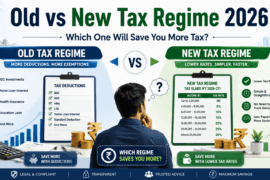
Old vs New Tax Regime 2026 is a decision that should not be made by looking at tax rates alone. Your salary structure, rent, home loan, insurance premiums and investments can completely change the result.
Take two people earning ₹15 lakh a year. One lives in a rented flat, claims HRA, pays a home-loan EMI and uses the full Section 80C limit. The other has no home loan, limited deductions and prefers flexible investments.
Their salaries are the same, but the tax regime that works for them may be different.
That is the real point of this comparison. The new regime may offer lower rates, but the old regime still allows deductions that can reduce taxable income. The better option is the one that results in a lower final tax bill not necessarily the one that looks more attractive at first.
This article covers income earned during FY 2025–26, for which the return is filed in AY 2026–27.
Old vs New Tax Regime 2026: The Basic Difference
The new tax Regime 2026 is now the default option. It offers wider tax slabs, lower rates and a simpler calculation. However, many popular deductions and exemptions are not available.
is now the default option. It offers wider tax slabs, lower rates and a simpler calculation. However, many popular deductions and exemptions are not available.
The old regime follows higher tax rates but allows benefits such as HRA exemption, Section 80C investments, health-insurance deductions and eligible home-loan interest.
Here is the difference at a glance:
| Feature | Old tax regime | New tax regime |
|---|---|---|
| Tax rates | Higher | Lower and more gradual |
| Standard deduction | ₹50,000 | ₹75,000 |
| HRA exemption | Available, subject to conditions | Not available |
| Section 80C | Available up to ₹1.5 lakh | Generally not available |
| Section 80D | Available | Generally not available |
| Self-occupied home-loan interest | Available, subject to conditions | Not available |
| Paperwork | More | Less |
| Best suited for | Taxpayers with substantial deductions | Taxpayers with limited deductions |
The Income Tax Department describes the new regime as a lower-rate system with limited deductions, while the old regime allows a wider range of exemptions and tax benefits. It also recommends comparing the liability under both systems before choosing. (Income Tax Department: Old vs New Regime FAQs)
Tax Slabs Under the New Regime for AY 2026–27
The new tax regime uses the following slabs:
| Taxable income | Tax rate |
| Up to ₹4,00,000 | Nil |
| ₹4,00,001 to ₹8,00,000 | 5% |
| ₹8,00,001 to ₹12,00,000 | 10% |
| ₹12,00,001 to ₹16,00,000 | 15% |
| ₹16,00,001 to ₹20,00,000 | 20% |
| ₹20,00,001 to ₹24,00,000 | 25% |
| Above ₹24,00,000 | 30% |
These are progressive tax slabs.
For example, if your taxable income falls in the 20% bracket, your entire income is not taxed at 20%. Only the part that falls within that slab is taxed at that rate.
The revised slabs and the ₹12 lakh rebate threshold were announced in the Union Budget 2025–26 and apply to AY 2026–27.
What About the Old Tax Regime Slabs?
For an individual below 60 years of age, the old regime continues with the familiar structure:
| Taxable income | Tax rate |
| Up to ₹2,50,000 | Nil |
| ₹2,50,001 to ₹5,00,000 | 5% |
| ₹5,00,001 to ₹10,00,000 | 20% |
| Above ₹10,00,000 | 30% |
At first, the new regime clearly looks better. Its tax Regime 2026 brackets are wider, and the 30% rate begins only above ₹24 lakh.
But this is where the calculation becomes personal.
The old regime allows you to reduce taxable income before applying those rates. If your deductions are large enough, the higher slab rates may not matter as much.
The official AY 2026–27 guidance lists both old and new regime slabs and confirms that the new system is the default regime.
The ₹12 Lakh Rebate Makes the New Regime Attractive
One of the biggest advantages of the new regime is the rebate under Section 87A.
A resident individual with eligible taxable income of up to ₹12 lakh can receive a rebate of up to ₹60,000. Salaried taxpayers may also claim a standard deduction of ₹75,000.
This means that a salaried person earning up to ₹12.75 lakh may potentially pay no regular income tax under the new regime.
However, the nature of the income matters.
The zero-tax benefit is designed for normal slab-rate income. Certain income taxed at special rates, including some capital gains, may not receive the same treatment. So, someone earning salary as well as profit from shares should calculate the liability carefully rather than assuming that income below ₹12.75 lakh will always be completely tax-free.
When the Old Tax Regime Can Still Save More
The old regime starts becoming relevant when several deductions come together.
A small insurance premium or a partial Section 80C investment may not be enough. But HRA, home-loan interest, health insurance and retirement contributions combined can reduce taxable income by several lakh rupees.
HRA exemption
Suppose you work in Bengaluru or Delhi and pay ₹25,000 to ₹30,000 in rent every month.
If your salary includes House Rent Allowance, an eligible portion may be exempt under the old regime. The actual amount depends on your salary, rent paid, HRA received and city of residence.
The full HRA mentioned on your salary slip is not automatically tax-free.
Under the new regime, the normal HRA exemption is not available.
Section 80C investments
Under the old regime, eligible payments and investments can be claimed under Section 80C, subject to a combined limit of ₹1.5 lakh.
These may include:
- Employees’ Provident Fund contributions
- Public Provident Fund
- Eligible life-insurance premiums
- Equity Linked Savings Schemes
- National Savings Certificates
- Certain tuition fees
- Qualifying home-loan principal repayment
The limit is shared across all eligible items.
For instance, if ₹1 lakh has already been contributed to EPF through your salary, only another ₹50,000 of eligible investment is needed to use the complete limit. Investing more will not increase the Section 80C deduction beyond ₹1.5 lakh.
Health insurance and NPS
Eligible health-insurance premiums may be claimed under Section 80D in the old regime. The standard limit is ₹25,000 for eligible cover for yourself and your family, with higher limits in cases involving older insured people. Separate benefits may also apply to eligible premiums paid for parents.
A personal contribution to the National Pension System may also qualify for an additional deduction of up to ₹50,000 under Section 80CCD(1B), subject to the applicable rules.
Old vs New Tax Regime 2026. These deductions are useful, but they should not push you into unsuitable financial products.
An investment chosen only to save tax may come with a long lock-in period, limited liquidity or charges that do not suit your financial goals.
Home-Loan Interest Can Change the Result
Old vs New Tax Regime 2026
People with a qualifying housing loan should compare both regimes carefully.
Under the old regime, eligible interest on a loan for a self-occupied property may be claimed up to ₹2 lakh under Section 24(b), subject to the applicable conditions.
The corresponding deduction for a self-occupied property is not available under the new regime.
Still, a tax deduction should not be treated as a reason to take a loan.
If you pay ₹2 lakh in interest, you do not save ₹2 lakh in tax. You only reduce taxable income by the eligible amount. The actual saving depends on your slab rate.
Example 1: ₹12 Lakh Salary With No Major Deductions
Suppose your annual salary is ₹12 lakh. You do not claim a major HRA exemption, do not have a home loan and have limited tax-saving investments.
Under the new regime:
- Gross salary: ₹12,00,000
- Standard deduction: ₹75,000
- Taxable income: ₹11,25,000
- Tax before rebate: ₹52,500
- Section 87A rebate: ₹52,500
- Regular income tax after rebate: Nil
Under the old regime:
- Gross salary: ₹12,00,000
- Standard deduction: ₹50,000
- Taxable income: ₹11,50,000
- Approximate tax including 4% cess: ₹1,63,800
In this case, the answer is straightforward. The new regime saves significantly more tax.
There is little benefit in making rushed investments at the end of the financial year merely to reduce tax under the old system.
The AY 2026–27 validation rules permit a standard deduction of up to ₹50,000 in the old regime and ₹75,000 in the new regime.
https://www.qaskme.com/itr-filing-2026-10-mistakes-that-can-delay-your-tax-refund/
Example 2: ₹18 Lakh Salary With Rent and a Home Loan
Now consider a different situation.
You earn ₹18 lakh, live in a rented flat near your office and own a house in another city. You also pay health-insurance premiums and use the complete Section 80C limit.
Assume your eligible old-regime benefits are:
- Standard deduction: ₹50,000
- HRA exemption: ₹3,00,000
- Section 80C: ₹1,50,000
- Section 80D: ₹25,000
- Home-loan interest: ₹2,00,000
Your taxable income under the old regime would be approximately ₹10.75 lakh.
The estimated tax, including cess, would be around ₹1,40,400.
Under the new regime, your taxable income after the ₹75,000 standard deduction would be ₹17.25 lakh. The estimated tax, including cess, would be around ₹1,50,800.
Here, the old regime saves approximately ₹10,400.
The difference is not huge, but it shows why taxpayers with high rent and a housing loan should not select the new regime without checking the numbers.
Which Tax Regime Is Better for You?
The new regime is more likely to work in your favour when:
- You have limited deductions
- You do not claim HRA
- You do not have a qualifying home loan
- You prefer flexible investments
- Your taxable income falls within the Section 87A rebate limit
- You want a simpler tax calculation
The old regime deserves closer attention when:
- You claim substantial HRA
- You use the complete Section 80C limit
- You have eligible home-loan interest
- You pay health-insurance premiums
- You contribute separately to NPS
- Your combined deductions run into several lakh rupees
There is no fixed income level at which one regime becomes better for everyone.
The break-even point changes with your deductions.
Do Not Compare the Regimes Using CTC Alone
This is another common mistake.
Your CTC may include employer contributions, insurance, bonuses and other benefits. It is not always the same as your taxable salary.
Use your salary slips, Form 16 and actual income details.
Also include:
- Salary from a previous employer
- Bank and fixed-deposit interest
- Rental income
- Dividends
- Freelance income
- Capital gains
- Any other taxable receipts
A job change during the year can make the calculation particularly tricky. Each employer may have deducted TDS based only on the salary paid by that organisation.
Your final return must include income from both jobs.
Can You Switch Between the Old and New Tax Regimes?
Taxpayers without business or professional income can generally choose between the two regimes each year while filing their return.
The rules are more restrictive for people with business or professional income. They may need to submit Form 10-IEA and cannot freely switch every year in the same way as salaried taxpayers without business income.
This detail matters for freelancers, consultants and people earning business income in addition to salary.
Old vs New Tax Regime 2026: Final Verdict
For most salaried taxpayers with low or moderate deductions, the new tax regime is likely to save more tax in 2026.
Its wider tax slabs, ₹75,000 standard deduction and enhanced Section 87A rebate give it a strong advantage.
The old tax regime can still be better when you have substantial HRA, home-loan interest, Section 80C investments, health-insurance premiums and other eligible deductions.
The safest method is simple.
Calculate your tax twice once under each regime.
Use your actual income. Claim only the deductions for which you are eligible. Then compare the final amount, including cess.
Do not choose a tax regime because your colleague selected it. Their salary may be similar, but their rent, investments and financial commitments may be completely different.
For the latest rules and filing guidance, visit the official Income Tax e-Filing Portal and the Union Budget website.