
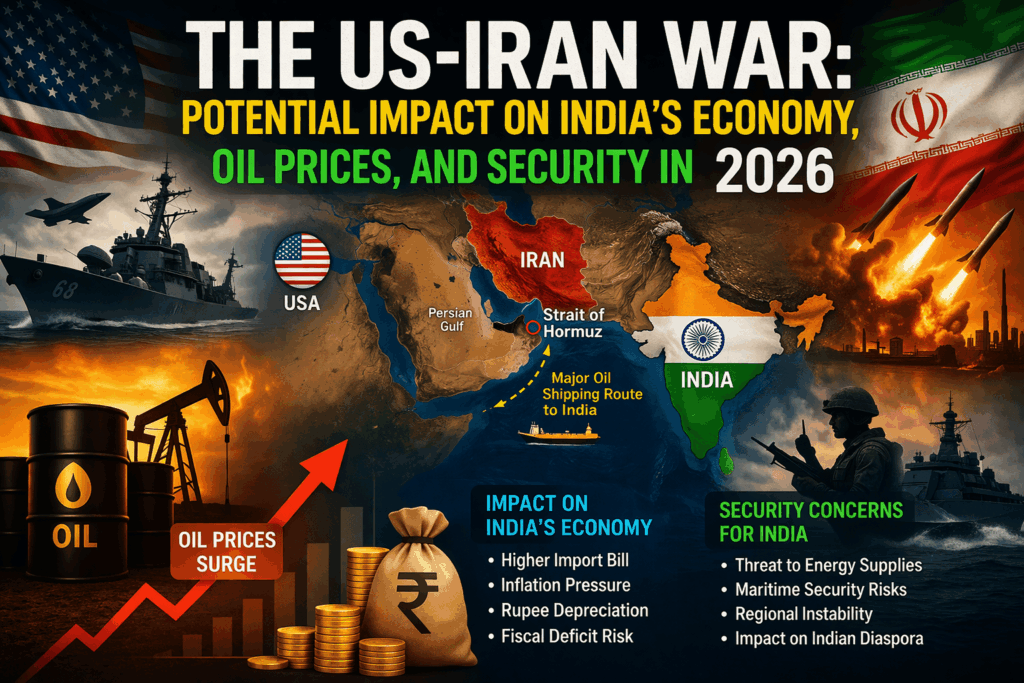
The 2026 of US on India’s economy, oil prices, and security is becoming one of the most important geopolitical concerns for policymakers, investors, businesses, and households across. Even though India is not directly involved in the conflict, the country’s strong economic links with West Asia mean that any escalation between the United States and Iran can quickly affect fuel prices, inflation, trade flows, and national security planning.
India imports nearly 90% of its crude oil requirements from overseas, making it especially sensitive to disruptions in Middle East shipping routes and global energy markets.
Because oil prices influence transportation, agriculture, manufacturing, and daily household expenses, the effects of the US-Iran conflict could reach every part of the Indian economy in 2026.
To explore how Middle East tensions affect global trade flows, visit:
👉 https://www.weforum.org/stories/2026/03/us-trade-deficit-international-trade-stories-march-2026/
2026 Impact of US-Iran War on India’s Oil Prices and Energy Security
Why the 2026 US-Iran War Could Increase Oil Prices in India
One of the most immediate consequences of the 2026 impact of US-Iran war on India’s oil prices comes from tensions around the Strait of Hormuz.
Nearly 40% of India’s crude oil imports pass through this strategic route, making the country highly exposed to supply disruptions.
If conflict affects tanker movement in this region:
- petrol prices may rise
- diesel transportation costs may increase
- aviation fuel prices could climb
- logistics expenses may expand nationwide
Even temporary shipping delays can create ripple effects across India’s economy.
To understand India’s oil dependency risks further:
👉 https://www.india-briefing.com/news/iran-conflict-impact-india-oil-rupee-trade-inflation-43160.html/
LPG and Natural Gas Supply Risks for Indian Households in 2026
The 2026 impact of US-Iran war on India’s cooking gas and LNG supply is another critical concern.
Nearly:
- 60% of India’s LPG demand is imported
- about 90% of LPG imports pass through Gulf shipping routes
If the conflict escalates, households across India could experience:
- delayed deliveries
- subsidy pressure on government budgets
- increased refill costs
Energy affordability remains an important issue for both urban and rural families.
2026 Impact of US-Iran War on India’s Trade and Supply Chains
Strait of Hormuz Disruptions and India’s Import Exposure
The 2026 impact of US-Iran war on India’s trade routes is significant because almost 20% of India’s total imports pass through the Strait of Hormuz corridor.
These imports include:
- crude oil
- fertilizers
- petrochemicals
- bullion
- industrial chemicals
Any shipping disruption could affect industries across sectors such as agriculture, manufacturing, and construction.
Learn more about shipping-route exposure here:
👉 https://www.moneycontrol.com/news/business/economy/hormuz-shock-us-iran-war-puts-nearly-a-fifth-of-india-s-imports-at-risk-13849299.html
Fertilizer Supply and Agricultural Impact on India in 2026
The 2026 impact of US-Iran war on India’s fertilizer imports could directly influence farmers and food prices.
India imports roughly 40% of fertilizers from Middle East suppliers, many of which depend on natural-gas-based production.
If fertilizer costs increase:
- farm production expenses rise
- food inflation may increase
- rural income stability may face pressure
Because agriculture supports millions of livelihoods in India, fertilizer supply security is closely linked to national economic stability.
2026 Impact of US-Iran War on India’s Inflation and Rupee Stability
Inflation Risks from Rising Energy Prices in India
The 2026 impact of US-Iran war on India’s inflation is strongly linked to rising fuel costs.
When oil prices rise globally:
transportation becomes expensive
manufacturing costs increase
food supply chains become costlier
Recent analysis shows global energy prices surged sharply after conflict escalation, with crude crossing $110 per barrel in early 2026.
This creates inflation pressure across developing economies like India.
Rupee Depreciation Risks During the US-Iran Conflict in 2026
The 2026 impact of US-Iran war on India’s currency stability is another important concern.
When investors move money toward safer markets during global crises:
- emerging-market currencies weaken
- import bills rise
- inflation increases further
Higher crude prices alone can significantly increase India’s external payment obligations and current-account deficit.
2026 Impact of US-Iran War on India’s National Security
Maritime Security Challenges for India in 2026
The 2026 impact of US-Iran war on India’s maritime security involves protecting shipping routes across the Arabian Sea.
India depends heavily on:
- sea-based energy imports
- cargo shipping lanes
- overseas trade corridors
If tensions escalate further, India may increase naval deployments to protect supply routes and ensure uninterrupted trade flows.
Safety of Indian Citizens in the Gulf Region
Millions of Indians live and work in West Asian countries.
The 2026 impact of US-Iran war on India’s overseas workforce security could include:
- evacuation challenges
- employment uncertainty
- remittance disruptions
Since remittances contribute significantly to household incomes in many Indian states, protecting overseas citizens remains a top priority.
2026 Impact of US-Iran War on India’s Stock Market and Investment Climate
Market Volatility Risks During the US-Iran Conflict
The 2026 impact of US-Iran war on India’s stock markets can be seen through investor reactions to oil price movements.
Typically:
energy companies benefit
aviation companies face higher costs
logistics firms experience pressure
import-dependent sectors see margin stress
Global supply-chain disruptions from the conflict are expected to keep inflation elevated for several years.
Long-Term Investment Opportunities for India Despite the Conflict
Despite risks, the 2026 impact of US-Iran war on India’s strategic economy could also create opportunities.
India may benefit from:
- renewable-energy expansion
- domestic manufacturing growth
- alternative trade partnerships
- supply-chain diversification
Such developments could strengthen India’s long-term economic resilience.
2026 Impact of US-Iran War on India’s Foreign Policy Strategy
India’s Balanced Diplomatic Role Between the US and Iran
India maintains strategic relationships with both the United States and Iran.
The 2026 impact of US-Iran war on India’s diplomatic strategy highlights the importance of balanced engagement that protects:
energy security
regional stability
trade continuity
This balanced approach helps India remain flexible during global geopolitical uncertainty.
Expanding Strategic Partnerships Beyond West Asia
To reduce exposure to conflict-affected regions, India is strengthening partnerships with:
Southeast Asia
Europe
Africa
Central Asia
These partnerships support supply-chain resilience and economic stability.
How Is Preparing for the US-Iran War on the Economy, Oil Prices, and Security
India has already taken several steps to reduce vulnerability:
- diversifying oil import sources
- strengthening strategic petroleum reserves
- monitoring inflation risks
- improving naval readiness
Recent reports also confirm India resumed limited Iranian oil purchases after temporary sanction flexibility helped stabilize supply availability.
Such developments demonstrate India’s preparedness despite ongoing geopolitical uncertainty.
Conclusion: What the 2026 Impact of US-Iran War Means for India’s Future
The 2026 impact of US-Iran war on India’s economy, oil prices, and security could be significant but manageable with strong planning and diversification strategies.
Key risks include:
higher fuel prices
inflation pressure
trade disruptions
currency volatility
maritime security concerns
However, India’s diversified energy sourcing strategy, diplomatic flexibility, and emergency reserves provide strong protection against long-term disruption.
With continued policy planning and global cooperation, India is well positioned to manage geopolitical uncertainty while sustaining economic growth in 2026 and beyond.