
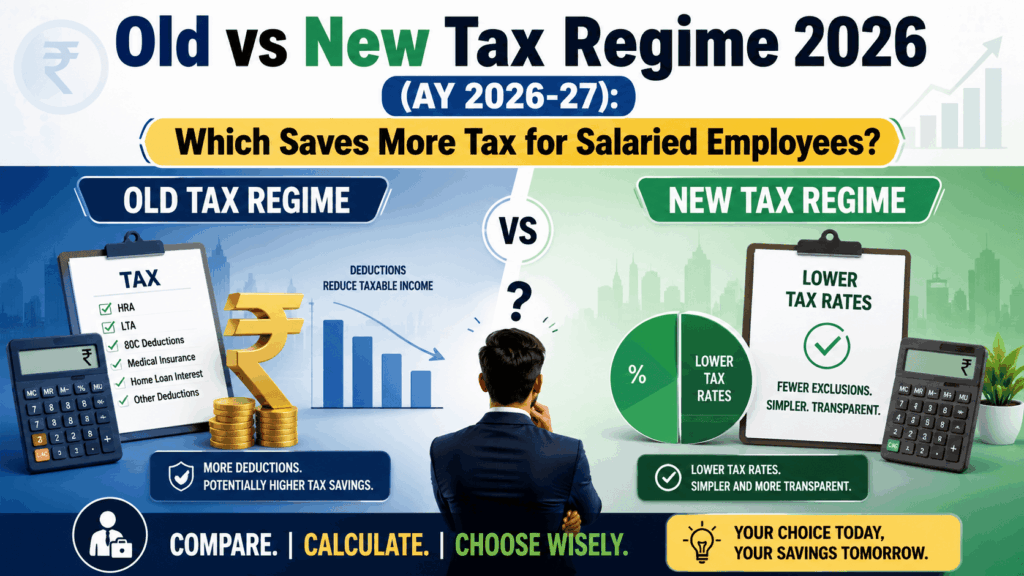
Old vs New Tax Regime Two employees can earn the same salary and still make completely different tax choices. One may save more under the new tax regime, while the other may find the old regime cheaper because of rent, a home loan, health insurance and other eligible deductions.
The Old vs New Tax Regime 2026 comparison should not be based on a colleague’s advice or a quick look at the tax slabs. Your salary is only one part of the calculation. Your HRA, investments, insurance premiums, employer’s NPS contribution, housing-loan interest and other income also matter.
For Assessment Year 2026-27, the new regime has become much more attractive. It offers wider tax slabs, a ₹75,000 standard deduction for salaried taxpayers and a rebate that can reduce regular income tax to zero when eligible taxable income does not exceed ₹12 lakh.
The old regime, however, has not become useless. It can still work well for people who claim a substantial HRA exemption and use several deductions together.
Let us compare both options without making the explanation more complicated than it needs to be.
Which income year does AY 2026-27 cover?
Assessment Year 2026-27 relates to income earned between 1 April 2025 and 31 March 2026, which is Financial Year 2025-26.
Although the Income Tax Act, 2025 came into effect from 1 April 2026, returns relating to income earned during FY 2025-26 are still filed for AY 2026-27 under the Income Tax Act, 1961.
The new tax regime is the default option. Salaried taxpayers without business or professional income can generally choose between the two regimes every year while filing their return on time. People with business or professional income face different switching rules and may need to file Form 10-IEA.
New Tax Regime Slabs for AY 2026-27
The new regime uses the following tax slabs:
| Taxable income | Tax rate |
|---|---|
| Up to ₹4,00,000 | Nil |
| ₹4,00,001 to ₹8,00,000 | 5% |
| ₹8,00,001 to ₹12,00,000 | 10% |
| ₹12,00,001 to ₹16,00,000 | 15% |
| ₹16,00,001 to ₹20,00,000 | 20% |
| ₹20,00,001 to ₹24,00,000 | 25% |
| Above ₹24,00,000 | 30% |
These rates apply progressively. Earning ₹15 lakh does not mean that the whole amount is taxed at 15%. The first ₹4 lakh is tax-free, and each remaining portion is taxed according to the slab in which it falls
.https://www.qaskme.com/old-vs-new-tax-regime-2026-which-one-will-save-you-more-tax/
How can a ₹12.75 lakh salary become tax-free?
Under the new regime, an eligible resident individual can claim a rebate of up to ₹60,000 under Section 87A when taxable income does not exceed ₹12 lakh.
Salaried taxpayers also receive a standard deduction of ₹75,000. Therefore, a person earning a gross salary of up to ₹12.75 lakh may have no regular income-tax liability after the standard deduction.
There is an important catch. The rebate does not necessarily remove tax payable on income taxed at special rates, such as certain capital gains. Someone who sold shares, mutual funds, cryptocurrency or property should calculate the tax carefully rather than assuming that all income up to ₹12 lakh is automatically tax-free.
Old Tax Regime Slabs for AY 2026-27
For an individual below 60 years of age, the old-regime slabs are:
| Taxable income | Tax rate |
|---|---|
| Up to ₹2,50,000 | Nil |
| ₹2,50,001 to ₹5,00,000 | 5% |
| ₹5,00,001 to ₹10,00,000 | 20% |
| Above ₹10,00,000 | 30% |
An eligible resident individual can receive a rebate of up to ₹12,500 when taxable income under the old regime does not exceed ₹5 lakh.
A 4% Health and Education Cess applies to the calculated tax under both regimes. Old-regime exemption limits differ for taxpayers aged 60 or above, so age also affects the final comparison.
Old vs New Tax Regime 2026: What is the actual difference?
The new regime gives you lower and wider tax slabs, but it does not allow most of the deductions commonly used by salaried taxpayers.
The old regime has higher rates, but it allows eligible taxpayers to reduce taxable income through HRA, Section 80C, health insurance, NPS contributions and housing-loan interest.
| Tax benefit | Old regime | New regime |
|---|---|---|
| Standard deduction | ₹50,000 | ₹75,000 |
| HRA exemption | Available | Not available |
| Section 80C | Up to ₹1.5 lakh | Not available |
| Personal NPS deduction under Section 80CCD(1B) | Up to ₹50,000 | Not available |
| Health insurance under Section 80D | Available | Not available |
| Interest on eligible self-occupied home loan | Up to ₹2 lakh | Not available in the same way |
| Employer NPS contribution | Available, subject to limits | Available, subject to limits |
| Supporting documents | More records required | Fewer deductions to document |
The Old vs New Tax Regime 2026 decision mainly comes down to whether the tax saved through old-regime deductions is large enough to offset its higher slab rates.
The new regime is sometimes described as a regime without deductions, but that is not entirely accurate. Certain benefits remain available, including an eligible employer contribution to NPS under Section 80CCD(2).
Why Section 80C alone may not make the old regime better
A common assumption is that using the full ₹1.5 lakh Section 80C limit automatically makes the old regime cheaper.
For AY 2026-27, that will often not be enough.
The new regime already gives taxpayers the benefit of wider slabs and a higher standard deduction. To make the old regime competitive, many salaried taxpayers will need more than EPF contributions or one tax-saving investment.
The old regime becomes more interesting when several benefits come together—for example, a large HRA exemption, ₹1.5 lakh under Section 80C, an additional NPS deduction, health insurance and home-loan interest.
That combination can reduce taxable income considerably. Without it, the new regime may still leave you with a smaller tax bill.
HRA can change the answer
For employees living in rented accommodation, HRA can be the biggest reason to calculate the old regime properly.
The eligible exemption depends on the HRA received, rent paid, salary components and the city of residence. It is not always equal to the full HRA shown on the salary slip or the total rent paid during the year.
Consider two employees earning ₹15 lakh each. One lives with family and does not pay rent. The other pays substantial rent and receives HRA as part of the salary package.
The first employee may find the new regime clearly better. The second may save more under the old regime after claiming a valid HRA exemption along with other deductions.
HRA exemption is available under the old regime but not under the new regime.
Which deductions still matter under the old regime?
Section 80C remains the most familiar deduction. The combined limit of ₹1.5 lakh may include eligible EPF contributions, PPF deposits, life insurance premiums, ELSS investments, tuition fees, National Savings Certificates and housing-loan principal repayment.
An additional deduction of up to ₹50,000 may be claimed for an eligible personal contribution to the National Pension System under Section 80CCD(1B).
Health insurance premiums may qualify under Section 80D. The usual deduction limit is ₹25,000 for self, spouse and dependent children, with a separate limit for parents. Higher limits may apply where the insured person satisfies the applicable age condition.
For an eligible self-occupied property, housing-loan interest of up to ₹2 lakh may be claimed under Section 24(b), subject to the required conditions.
These deductions can help, but they should arise from genuine financial needs. Buying an unsuitable insurance policy or locking money into an investment only to reduce tax may do more harm than good.
Old vs New Tax Regime 2026 salary-wise comparison
The table below provides a basic comparison for an employee below 60 years of age.
It assumes that:
- The entire income is salary income.
- There is no capital gain or other special-rate income.
- The new regime includes a ₹75,000 standard deduction.
- The old regime includes only a ₹50,000 standard deduction.
- No additional old-regime exemptions or deductions are claimed.
- Health and Education Cess of 4% is included.
| Gross annual salary | New-regime tax | Old-regime tax |
|---|---|---|
| ₹10,00,000 | ₹0 | ₹1,06,600 |
| ₹12,00,000 | ₹0 | ₹1,63,800 |
| ₹12,75,000 | ₹0 | ₹1,87,200 |
| ₹15,00,000 | ₹97,500 | ₹2,57,400 |
| ₹20,00,000 | ₹1,92,400 | ₹4,13,400 |
| ₹25,00,000 | ₹3,19,800 | ₹5,69,400 |
These figures make the new regime look like an easy winner. However, the old-regime column includes only the standard deduction. It does not yet account for HRA, Section 80C, NPS, medical insurance or housing-loan interest.
That is where individual circumstances begin to matter.
A realistic ₹15 lakh salary example
Suppose a salaried employee earns ₹15 lakh during the year.
Under the new regime, the ₹75,000 standard deduction brings taxable salary down to ₹14.25 lakh. The estimated tax, including cess, comes to ₹97,500.
Now imagine that the same employee can validly claim the following under the old regime:
| Exemption or deduction | Amount |
|---|---|
| Standard deduction | ₹50,000 |
| HRA exemption | ₹3,50,000 |
| Section 80C | ₹1,50,000 |
| Additional NPS contribution | ₹50,000 |
| Health insurance | ₹25,000 |
| Total reduction | ₹6,25,000 |
Taxable income under the old regime would fall to around ₹8.75 lakh. The estimated tax, including cess, would be approximately ₹91,000.
In this example, the old regime saves about ₹6,500.
This practical Old vs New Tax Regime 2026 example shows why salary alone cannot determine the better option. The result depends heavily on how much HRA and other eligible deductions the employee can actually claim.
It is not a huge difference, and it depends heavily on the ₹3.5 lakh HRA exemption. Remove that exemption, and the new regime becomes substantially cheaper.
For a ₹15 lakh salary, the old regime needs total valid exemptions and deductions of roughly ₹5.94 lakh, including the standard deduction, merely to match the new-regime liability in a straightforward salary-only calculation.
This is a more useful question than asking whether you have “done your 80C.”
Who is likely to save more under the new regime?
The new regime will usually be worth considering when you have limited deductions, do not receive a significant HRA exemption and do not have substantial housing-loan interest.
It may also suit people who do not want their investment decisions to be driven by tax deadlines. The wider slabs reduce tax without requiring a separate investment, while the ₹75,000 standard deduction is available directly to salaried taxpayers.
Employees earning up to ₹12.75 lakh may find it particularly attractive because the standard deduction can bring eligible taxable income within the ₹12 lakh rebate limit.
When might the old regime still win?
The old regime deserves a proper calculation when rent is a major monthly expense and HRA forms part of the salary.
It may also work better when the taxpayer uses the full Section 80C limit, contributes separately to NPS, pays health insurance premiums and has eligible housing-loan interest.
When comparing the Old vs New Tax Regime 2026, add all genuine exemptions and deductions before deciding. Comparing only the headline slab rates can give you the wrong result.
Two people with the same annual salary can therefore reach different conclusions. One may have almost no deductions beyond EPF, while the other may have ₹6 lakh or more in valid exemptions and deductions.
The salary figure is the same, but the taxable income is not.
Mistakes to avoid while comparing the regimes
Do not compare only the slab rates. The correct comparison is between the final tax liability after applying the deductions permitted under each regime.
Do not treat the full cost-to-company amount as taxable salary without checking its components. Employer contributions, reimbursements and benefits may have different tax treatment.
Do not claim the full HRA received as exempt without applying the prescribed calculation.
Remember to include bank interest, dividend income, rental income and capital gains. A comparison based only on salary may be misleading when other income is involved.
Also, the regime used by your employer for TDS is not always your final selection. An eligible non-business taxpayer can generally make the final choice while filing the return on time.
How should you make the final choice?
Start with your Form 16 and salary slips. Then collect rent records, investment proofs, insurance receipts, the home-loan interest certificate and your NPS statement.
Calculate taxable income and final tax under both regimes using the same income details.
The Income Tax Department provides an official Income and Tax Calculator that can help compare the two options.
Before submitting the return, match your salary and TDS details with Form 16, Form 26AS and the Annual Information Statement. A tax regime may look cheaper on paper, but an incorrect exemption or missing income can create trouble later.
Final verdict
For a large number of salaried taxpayers, the new regime is likely to result in lower tax for AY 2026-27. The revised slabs, ₹75,000 standard deduction and Section 87A rebate give it a strong advantage, especially when the taxpayer has limited deductions.
The old regime can still save more, but usually only when several valid benefits come together. A meaningful HRA exemption, Section 80C, NPS, health insurance and housing-loan interest can shift the calculation in its favour.
There is no single winner for every employee. The final Old vs New Tax Regime 2026 choice should be based on your actual salary structure, other income and valid deductions.
Use your actual salary structure and deductions, calculate both options and choose the one that produces the lower final tax. Do not select a regime simply because it worked for a friend or colleague—and do not make an unnecessary investment merely to claim a deduction.