
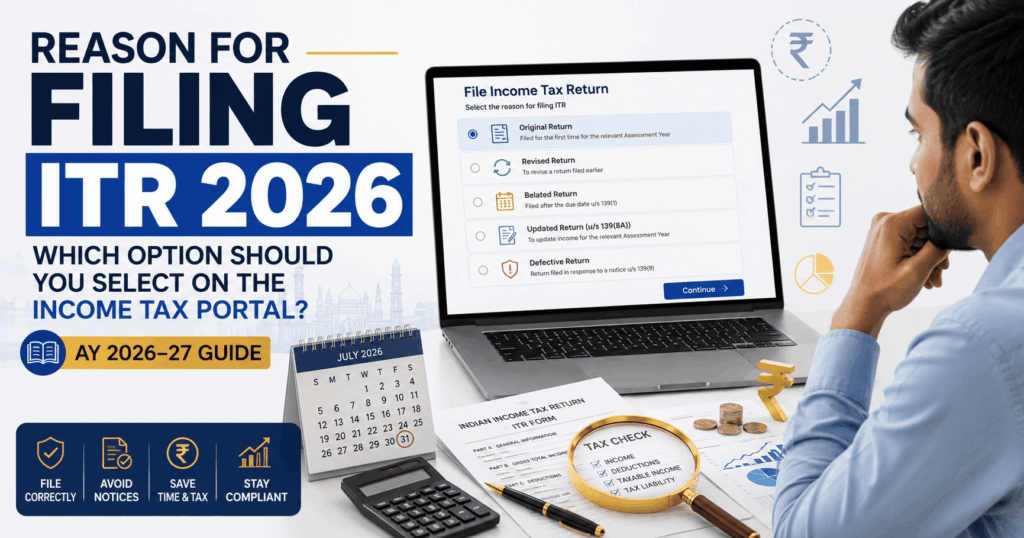
Reason for Filing ITR 2026 is one of the first questions you may see when filing your income tax return online. Although the question appears simple, many taxpayers are unsure whether to select “taxable income above the basic exemption limit,” choose one of the high-value transaction conditions, or select “Others.”
Choosing the correct option matters because it tells the Income Tax Department why you are filing your return. Your answer should match your income, transactions and legal filing requirement for Assessment Year 2026–27.
AY 2026–27 covers income earned during Financial Year 2025–26. Returns for this assessment year continue to be governed by the Income-tax Act, 1961, even though the Income-tax Act, 2025 came into force from 1 April 2026.
This guide explains each available option in simple language, provides practical examples and helps you select the correct reason for filing ITR on the Income Tax Portal.
Where does the “Reason for Filing ITR 2026” question appear?
To file your return, visit the official Income Tax e-Filing Portal and log in using your PAN and password.
After logging in, follow this route:
e-File → Income Tax Returns → File Income Tax Return
Select Assessment Year 2026–27, choose online filing and select the ITR form applicable to you. Once you click “Let’s Get Started,” the portal asks you to select the reason for filing your income tax return.
According to the official ITR-1 online filing manual, the portal requires taxpayers to choose the applicable reason before continuing with the return.
The main options generally shown are:
- Taxable income is more than the basic exemption limit
- Filing due to one or more conditions under the seventh proviso to Section 139(1)
- Others
Let us understand which one applies to you.
Reason for Filing ITR 2026: Income Above the Basic Exemption Limit
Select this option when your taxable income exceeds the basic exemption limit applicable to you.
For AY 2026–27, the basic exemption limit under the new tax regime is generally ₹4 lakh. Under the old tax regime, it is generally:
| Taxpayer category | Basic exemption limit under old regime |
|---|---|
| Individual below 60 years | ₹2.5 lakh |
| Individual aged 60 to below 80 years | ₹3 lakh |
| Individual aged 80 years or above | ₹5 lakh |
The Income Tax Department’s AY 2026–27 guidance for salaried taxpayers confirms the applicable tax slabs under the old and new regimes.
However, calculate the filing requirement carefully. For this purpose, income may need to be considered before claiming certain deductions and exemptions, including deductions under Sections 80C to 80U and specified capital-gains exemptions.
Basic exemption and tax rebate are not the same
One of the most common mistakes while selecting the Reason for Filing ITR 2026 is confusing the basic exemption limit with the Section 87A rebate limit.
Under the new tax regime, the nil-rate slab starts at ₹4 lakh. However, eligible resident individuals may receive a rebate that reduces their tax liability to zero when their taxable income does not exceed ₹12 lakh, subject to the applicable conditions.
Therefore, having no tax payable does not automatically mean that you are not required to file an ITR.
For example, suppose your taxable income under the new regime is ₹8 lakh. You may receive a rebate that reduces your final tax liability, but your income is still above the ₹4 lakh basic exemption limit. In this case, select:
“Taxable income is more than the basic exemption limit.”
The rebate affects the amount of tax payable. It does not change the reason for filing the return. The official AY 2026–27 guidance states that the Section 87A rebate under the new regime can apply where taxable income does not exceed ₹12 lakh.
Reason for Filing Income Tax Return Under Section 139(1) Conditions
Select this option when your income does not exceed the applicable basic exemption limit, but you are still required to file an ITR because of specified high-value transactions or other prescribed conditions.
After choosing this option, the portal asks you to select the relevant condition.
Current account deposits exceeding ₹1 crore
Select this condition when you deposited more than ₹1 crore in total across one or more current accounts during FY 2025–26.
The limit applies to the aggregate amount deposited, not merely the year-end balance.
For example, suppose your income is ₹3 lakh, but deposits totalling ₹1.10 crore were made in your current account during the year. Even though your income may be below the basic exemption limit, you may still have to file a return under this condition.
Savings accounts are not covered by this particular ₹1 crore condition. A separate prescribed condition may apply where savings-account deposits exceed ₹50 lakh.
Foreign travel expenditure exceeding ₹2 lakh
Select this condition when you spent more than ₹2 lakh on foreign travel during the financial year.
The expenditure may relate to travel for yourself or another person. Therefore, paying for a family member’s international trip may also be considered while checking the threshold.
This condition relates to travel expenditure. It does not apply merely because you travelled abroad.
Electricity expenditure exceeding ₹1 lakh
Select this condition when your total electricity expenditure exceeded ₹1 lakh during FY 2025–26.
The portal may ask you to enter the applicable amount. Review electricity bills and payments made during the year before selecting the option.
Other prescribed conditions
The portal also includes an option for other conditions prescribed under clause (iv) of the seventh proviso to Section 139(1).
These conditions may require filing when:
- Business turnover exceeds ₹60 lakh.
- Gross professional receipts exceed ₹10 lakh.
- Total TDS and TCS reaches ₹25,000 or more.
- Total TDS and TCS reaches ₹50,000 or more for a person covered by the higher age-based threshold.
- Deposits in savings accounts exceed ₹50 lakh.
The Income Tax Department lists these conditions as situations in which an individual may have to file an ITR even when income is below the exemption limit.
Therefore, do not select “Others” merely because the condition is not displayed as one of the first three checkboxes. Look for the option referring to other prescribed conditions and select the relevant item from the available menu.
Which Reason for Filing ITR Should You Select Under “Others”?
Select “Others” when neither of the first two options correctly explains why you are filing the return.
This option may be relevant when you are filing voluntarily, claiming an income tax refund or meeting another filing requirement that does not fall under the displayed high-value transaction conditions.
Possible situations include:
- Your income is below the basic exemption limit, but TDS was deducted and you want to claim a refund.
- You are voluntarily filing an ITR as proof of income.
- You need an ITR for a loan, visa or financial application.
- You need to report eligible losses and preserve the ability to carry them forward.
- You are required to report foreign assets, overseas financial interests or signing authority in an overseas account.
- Another statutory filing requirement applies, but your income is not above the basic exemption limit and the seventh-proviso transaction conditions do not apply.
Resident individuals who own, benefit from or have signing authority over specified foreign assets may have a mandatory filing obligation even when income is below the basic exemption limit.
However, foreign income and foreign asset reporting can be complex. Consider professional guidance when you hold overseas shares, foreign bank accounts, employee stock options, cryptocurrency through foreign exchanges or any other financial interest outside India.
Practical examples: Which reason for filing ITR should you select?
| Situation | Appropriate selection |
|---|---|
| Taxable income is ₹8 lakh under the new regime | Taxable income is more than the basic exemption limit |
| Income is ₹3 lakh and current-account deposits are ₹1.20 crore | Seventh proviso – current-account deposits above ₹1 crore |
| Income is below the exemption limit and foreign travel expenditure is ₹2.40 lakh | Seventh proviso – foreign travel expenditure above ₹2 lakh |
| Income is below the exemption limit and electricity expenditure is ₹1.15 lakh | Seventh proviso – electricity expenditure above ₹1 lakh |
| Income is below the exemption limit and savings-account deposits exceed ₹50 lakh | Seventh proviso – other prescribed condition |
| Income is below the exemption limit and TDS of ₹12,000 was deducted | Others, when filing to claim a refund |
| Income is below the exemption limit but you hold a reportable foreign asset | Others, along with complete foreign asset disclosure |
| Income exceeds the exemption limit, but no tax is payable because of rebate | Taxable income is more than the basic exemption limit |
These examples provide general guidance. Your final selection should be based on your residential status, income composition, tax regime and transaction details.
Do not confuse the filing reason with the type of return
The reason for filing ITR on the Income Tax Portal is different from the section under which the return is filed.
For example, you may be filing because your income exceeds the exemption limit. However, depending on when and why you are filing, the return may separately be classified as:
- Original return under Section 139(1)
- Belated return under Section 139(4)
- Revised return under Section 139(5)
- Return filed in response to a notice
- Updated return under Section 139(8A)
Suppose your income exceeds the basic exemption limit, but you file after the original due date. Your reason for filing may still be “taxable income is more than the basic exemption limit,” while the filing section may be Section 139(4) for a belated return.
Similarly, when correcting an earlier return, the portal may ask for the acknowledgement number and date of the original return. The notified AY 2026–27 forms separately capture the filing section, notice information and seventh-proviso filing conditions.
Important checks before selecting the reason for filing ITR
Before answering the Reason for Filing ITR 2026 question, review the following information:
Calculate income from every source
Include applicable income from salary, pension, house property, interest, dividends, capital gains, business, professional work and other taxable sources.
Do not rely only on Form 16. Income from bank deposits, investments and other activities may also affect your filing requirement.
Check AIS and Form 26AS
Compare your records with the Annual Information Statement, Taxpayer Information Summary and Form 26AS. Look for interest, securities transactions, TDS, TCS and high-value transactions.
A mismatch does not always mean the information is correct, but it should be reviewed before submitting the return.
Confirm your tax regime
The new tax regime is the default regime for eligible taxpayers. Non-business taxpayers can generally select their preferred regime through the ITR, while taxpayers with business or professional income may need to comply with Form 10-IEA requirements when opting out of or re-entering the default regime.
Check transaction thresholds separately
Your income may be below the exemption limit while your transactions still create a filing obligation. Check current accounts, savings accounts, foreign travel, electricity payments, business turnover, professional receipts and TDS/TCS totals separately.
Select the correct ITR form
Choosing the correct filing reason does not correct the use of an incorrect ITR form. Confirm whether you are eligible for ITR-1, ITR-2, ITR-3 or ITR-4 based on your income sources.
For example, the official ITR-1 guidance states that the form is generally available to eligible resident individuals with total income up to ₹50 lakh, subject to restrictions relating to business income, certain capital gains, foreign status and other specified matters.
Common mistakes to avoid
One common mistake is selecting “Others” without checking whether income exceeds the basic exemption limit. Another is selecting the high-value transaction option even though income itself already exceeds the exemption limit.
Taxpayers also sometimes assume that zero tax liability means ITR filing is unnecessary. As explained earlier, a rebate can reduce tax to zero even when income exceeds the basic exemption limit.
Do not select every available condition as a precaution. Select only the reason and transaction conditions that genuinely apply. Incorrect information can create inconsistencies between your return, AIS, Form 26AS and departmental records.
Final answer: Which option should you select?
The correct Reason for Filing ITR 2026 depends on your situation:
- Select “Taxable income is more than the basic exemption limit” when your income crosses the applicable exemption threshold.
- Select the seventh-proviso option when income is below the exemption limit but specified transactions or prescribed filing conditions apply.
- Select “Others” when you are filing voluntarily, claiming a refund or filing because of another requirement not covered by the first two options.
Review your income and transactions before continuing. Most importantly, do not choose an option simply because it appears convenient. The information should accurately reflect why you are legally or voluntarily filing your return.
For updated forms, utilities and official instructions, always refer to the Income Tax Department website before submitting your ITR.