

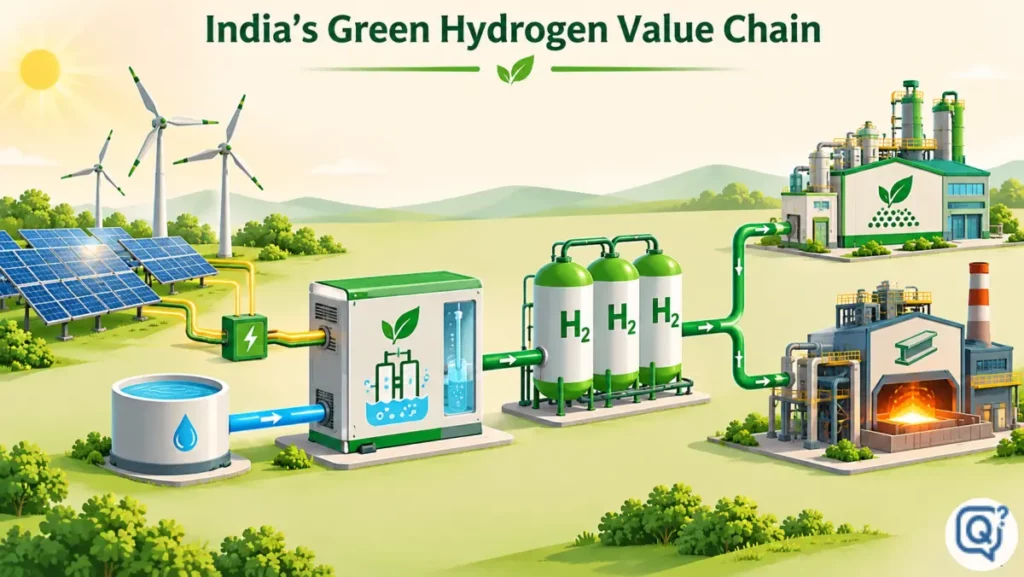
Green hydrogen careers become easier to understand when you follow the technology from electricity to its final use. A renewable-power project, an electrolyser plant and a fertiliser factory need different skills. Knowing where you fit is more useful than collecting a broad list of job titles.
Department and policy context: Ministry of New and Renewable Energy (MNRE), National Green Hydrogen Mission. This is a skills and policy explainer, not an official recruitment advertisement.
Green hydrogen careers begin with the production chain
In an electrolysis route, electricity is used to split water into hydrogen and oxygen. Calling the hydrogen green depends on the applicable renewable-energy and emissions requirements; the label is not established by the colour of equipment or a marketing claim. Start with the official mission resources when checking the Indian policy context.
The illustration follows a simplified chain: renewable electricity and prepared water enter an electrolyser, hydrogen is collected and stored, and an industrial facility uses it. A real project also needs controls, utilities, safety systems and infrastructure that a simplified diagram cannot fully show.
Where different skills can contribute
| Part of the chain | Work to explore | Evidence to build |
|---|---|---|
| Renewable electricity | Power-system design, integration and energy-supply planning | An electrical or energy-system project that explains your assumptions and results |
| Electrolyser equipment | Process operation, equipment development, controls and maintenance | Relevant technical study and supervised equipment or process experience |
| Water and utilities | Water treatment, utility integration and resource planning | A documented design or assessment using appropriate technical standards |
| Storage and movement | Compression, storage systems, materials and logistics | Relevant engineering knowledge and role-specific safety competence |
| Industrial use | Process integration in sectors such as fertilisers and steel | Experience with the receiving industrial process and its operating constraints |
| Project support | Procurement, environmental coordination, finance and progress monitoring | Clear examples of project outputs and your own contribution |
How to choose a realistic learning direction
First, write down your existing qualification and practical strengths. Then choose a part of the chain that uses them. An electrical engineer may investigate power integration, while someone with industrial procurement experience may be better placed to examine supply-chain work. Neither route should be described as automatically eligible for every hydrogen vacancy.
Next, compare a course with actual job descriptions. Look at the syllabus, laboratory access, assessment and the experience expected by employers. A course title alone does not tell you whether it develops the technical ability a role needs.
For a portfolio, explain the problem, inputs, assumptions and limits of your work. Use public data and cite its source. An energy-balance study, a process comparison or a procurement-risk map can demonstrate reasoning when prepared within your competence. Practical work on pressurised or flammable-gas systems requires appropriate facilities, training and supervision.
Mission targets are different from live vacancies
The National Green Hydrogen Mission sets forward-looking outcomes for production, investment and employment. These describe policy ambition. They are not a list of appointments available now, and they should not be presented as jobs already created.
Similarly, a project approval, a tender and a staff recruitment notice answer different questions. A tender may seek a supplier or consultant organisation. A job notice recruits an individual. Read the issuer, eligibility and submission route before deciding which type of opportunity you have found.
Check the source before applying
For a live opening, find the employer’s own notice and current application page. Confirm the post, work location, degree, experience and engagement type. Keep the application closing date separate from a website listing date or an interview date. If the documents conflict, seek the employer’s clarification rather than invent a deadline.
- Explore MNRE’s National Green Hydrogen Mission portal
- Download the official National Green Hydrogen Mission document (PDF)
Discuss green hydrogen careers on Qaskme
Ask which part of the green hydrogen value chain fits your skills. Mention the work you want to understand, your current learning stage and an official source if referring to a specific opportunity. Keep private certificates and personal contact details out of public replies.
Cover image: AI-generated editorial illustration, not an official recruitment notice.