

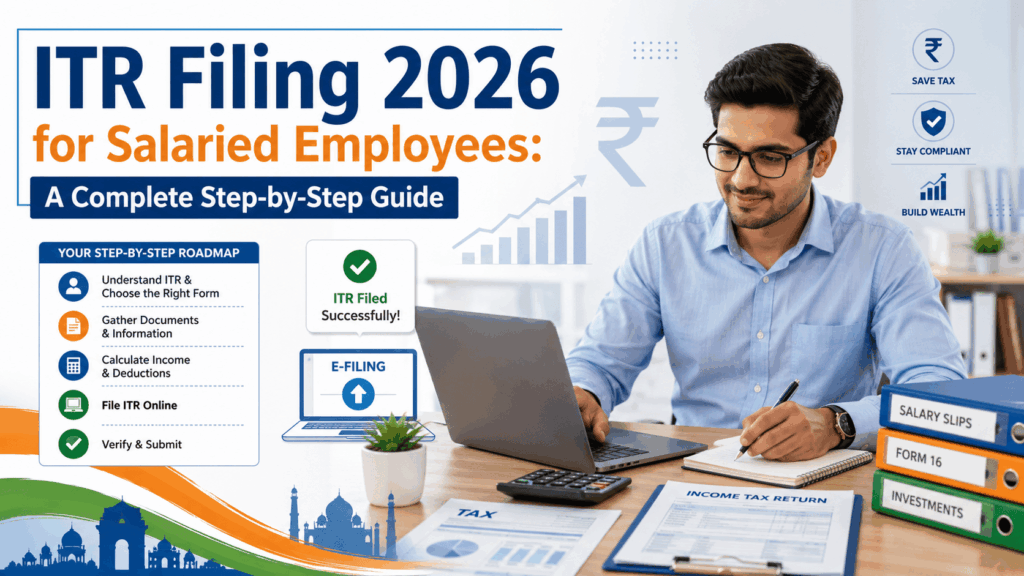
ITR Filing 2026 for Salaried Employees does not need to become a stressful July-night exercise involving ten browser tabs, missing passwords and last-minute calls to a tax consultant. For most salaried people, filing an income tax return is fairly manageable once salary, bank interest, investments and tax deductions are brought together in one place.
Income earned between 1 April 2025 and 31 March 2026 falls under Financial Year 2025–26 and is reported in Assessment Year 2026–27. The current filing deadline for most salaried individuals whose accounts do not require an audit is 31 July 2026. The Income Tax Department has also enabled online and offline filing for ITR-1, ITR-2, ITR-3 and ITR-4 for AY 2026–27.
Returns can be filed through the official Income Tax e-Filing Portal.
A quick word before we begin: this guide is meant for general salaried tax situations. Foreign assets, business income, complicated capital gains or multiple properties may require individual advice from a tax professional.
Salary Is Only One Part of Your Income Tax Return
ITR Filing 2026 for Salaried Employees
Most employees begin with Form 16, and that is the right place to start. The problem arises when Form 16 is treated as the complete tax return.
Your employer usually knows about the salary it paid and the declarations submitted through its payroll system. It may not know that you earned interest from a fixed deposit, received dividends, sold mutual fund units or collected rent from a property.
Take a fairly common case. Rohan changed jobs in September 2025. His previous employer deducted tax on the salary paid until August, while his new employer calculated TDS using only the income declared after he joined. He also had ₹24,000 of fixed-deposit interest.
If Rohan files his return using only the second employer’s Form 16, a large part of his annual income will be missing. Both salaries and the bank interest belong in the same return.
Small amounts count too. A bank may not deduct TDS on a particular interest amount, but that does not automatically make the interest tax-free.
Financial Year or Assessment Year? Keep This Simple
ITR Filing 2026 for Salaried Employees
The two terms sound unnecessarily similar.
The financial year is when you earn the income. The assessment year is when you report that income to the tax department.
For the return being filed in 2026:
- Income period: 1 April 2025 to 31 March 2026
- Financial Year: 2025–26
- Assessment Year: 2026–27
On the filing portal, choose AY 2026–27.
This takes only a second, yet selecting the wrong year can lead to tax-payment mismatches and unnecessary correction work later.
What to Keep Ready Before Starting ITR Filing 2026 for Salaried Employees
There is no benefit in opening the portal first and searching for documents halfway through the return. A small folder on your laptop containing the following records is usually enough.
https://www.qaskme.com/itr-filing-2026-10-mistakes-that-can-delay-your-tax-refund/
Form 16 and More Than One If You Changed Jobs
Form 16 gives you a summary of salary, exemptions, standard deduction, taxable income and TDS reported by your employer.
Anyone who worked for two employers during FY 2025–26 should collect Form 16 from both organisations. The figures then need to be combined while preparing the return.
16 may be central to salaried employee ITR filing, but it is not the only record that matters.
Form 26AS, AIS and Your Own Bank Records
26AS mainly helps you see the TDS and tax payments recorded against your PAN.
The Annual Information Statement, or AIS, goes further. It may show salary, interest, dividends, securities transactions, property transactions and other information reported by banks, employers and financial institutions.
AIS figures occasionally need context. A mutual fund sale of ₹3 lakh appearing in AIS does not mean that ₹3 lakh is automatically taxable. Tax is generally calculated on the applicable gain, not simply on the full sale amount.
Your own records still matter. Compare AIS and Form 26AS with bank statements, interest certificates, broker reports and Form 16 instead of treating any one document as the final answer.
For official guidance, the Income Tax Department provides information through its AIS section.
The Other Papers That May Be Useful
The documents vary from person to person. Someone with only salary and savings-account interest may need very little. A homeowner or investor will naturally need more.
Useful records can include:
- Bank interest certificates
- Home-loan interest certificate
- Rent receipts and rental agreement
- Health-insurance premium receipts
- NPS contribution records
- Donation receipts
- Capital-gain statements from a broker or mutual fund platform
- Self-assessment or advance-tax challans
There is no need to upload most of these documents with the return, but the figures entered should be supported by genuine records.
Which ITR Form Is Right for a Salaried Employee?
Many people select ITR-1 simply because they receive a salary. Salary alone does not decide the form; your other income and financial circumstances matter too.
ITR-1 Works for Straightforward Cases
ITR-1, also called Sahaj, is designed for eligible resident individuals with total income up to ₹50 lakh from permitted sources. For AY 2026–27, the form can cover salary or pension, eligible interest and dividend income, limited agricultural income and eligible long-term capital gains under Section 112A up to ₹1.25 lakh.
It cannot be used in situations involving short-term capital gains, business or professional income, foreign assets, foreign income, company directorship and several other exclusions. The latest AY 2026–27 eligibility and exclusions are available in the official ITR-1 FAQs.
ITR-2 Is Common When Investments Make the Return More Complex
A salaried individual may need ITR-2 when ITR-1 is not available but there is no business or professional income.
This often applies to people with short-term capital gains, certain larger or more complex capital gains, foreign assets, foreign income or other circumstances excluded from ITR-1.
Owning shares does not automatically mean that ITR-2 is required. The nature of the transaction and resulting income matter.
Salary Plus Professional Work Can Change the Form
Freelance projects, consulting assignments and side businesses should not be mixed casually with ordinary salary income.
A developer working full-time who also receives professional fees from private clients may have business or professional income. Depending on the facts, ITR-3 or ITR-4 could become relevant.
The Income Tax Department’s salaried individual guidance for AY 2026–27 provides an overview of the available forms.
Old vs New Tax Regime: The Better Option Is Personal
The new tax regime is designed around lower slab rates with fewer traditional exemptions and deductions. The old regime retains deductions such as Section 80C, Section 80D, HRA and eligible home-loan benefits.
There is no universal winner.
A colleague with the same salary may pay a different amount of tax because they have a home loan, pay rent, invest under Section 80C or cover family members through health insurance.
New Tax Regime Slabs for FY 2025–26
| Taxable income | Tax rate |
|---|---|
| Up to ₹4,00,000 | Nil |
| ₹4,00,001 to ₹8,00,000 | 5% |
| ₹8,00,001 to ₹12,00,000 | 10% |
| ₹12,00,001 to ₹16,00,000 | 15% |
| ₹16,00,001 to ₹20,00,000 | 20% |
| ₹20,00,001 to ₹24,00,000 | 25% |
| Above ₹24,00,000 | 30% |
Under the new regime, eligible resident individuals can receive a rebate that results in no tax payable on ordinary income up to ₹12 lakh. Salaried taxpayers also receive a standard deduction of ₹75,000, making the effective no-tax salary level up to ₹12.75 lakh in eligible cases. Special-rate income, including certain capital gains, is treated separately and can change the result.
The old regime may still work better where deductions are substantial. Someone claiming HRA, home-loan interest, health-insurance premiums and the full available Section 80C benefit should calculate both options rather than relying on a general rule.
The Actual ITR E-Filing Process, Without the Portal Jargon
Begin with Your Profile and Bank Account
Log in to the official e-Filing Portal using your PAN.
Before moving to the return, look at the contact and bank details saved in your profile. An outdated phone number can create problems with OTPs, while an inactive bank account can complicate a refund.
Once inside, follow:
e-File → Income Tax Returns → File Income Tax Return
Choose AY 2026–27, select the filing mode and continue as an individual taxpayer.
Let the Form Open, but Do Not Trust Every Pre-Filled Number
The portal may already display personal information, salary, TDS and interest data.
That saves time, but pre-filled information is not a substitute for your own records. Salary should agree with Form 16, TDS should reconcile with Form 26AS, and interest should make sense when compared with bank certificates.
A difference is not always a tax error. It may be an old fixed deposit, a joint account, an employer correction pending in the system or a transaction that needs to be understood before it is accepted.
Bring All Salary Income Together
People who remained with one employer throughout the year usually find this section easy.
Job changers need to slow down here.
Salary, taxable allowances, standard deduction and TDS from every employer belong in the return. Payroll systems do not always communicate with each other, so the final return is where the complete annual picture comes together.
This is also why someone may find additional tax payable even though both employers deducted TDS.
Add the Income That Never Appeared in Form 16
Savings interest, fixed-deposit interest, dividends, rent and income-tax refund interest are easy to overlook because they may be spread across different statements.
Capital gains need more care. Broker reports can help, although the figures should still match the tax treatment applicable to the transaction.
A sale amount and a taxable gain are not the same thing.
Enter Deductions According to the Regime Selected
Claims under the old regime may include eligible deductions under Sections 80C, 80D, 80E and 80G, along with permitted exemptions and home-loan benefits.
Many of these claims are not available under the new regime.
The portal may carry forward information from earlier records, so an old deduction should not be accepted automatically. Its availability depends on the selected regime and the current year’s eligibility.
When the Calculation Shows Extra Tax
ITR Filing 2026 for Salaried Employees.
Additional tax at the filing stage is not unusual.
It often appears after combining income from two employers, adding bank interest or including capital gains that were not considered in payroll TDS.
Self-assessment tax can be paid through the portal. For a payment relating to income earned in FY 2025–26, the relevant assessment year is AY 2026–27. After payment, the challan details should appear in the return before submission.
Read the Final Page Like a Bank Statement
The final preview deserves more attention than the earlier screens.
Look at the total income, tax regime, TDS credit, tax payable or refund amount and the bank account selected for the refund. If something appears unexpectedly high or low, going back one section is easier than revising a filed return later.
Submit only after the figures tell a story that matches your actual year.
Filing Is Not Finished Until the Return Is Verified
A successfully uploaded return still needs verification.
Most salaried taxpayers use Aadhaar OTP, net banking or an Electronic Verification Code generated through a pre-validated bank or demat account. Digital Signature Certificate and physical ITR-V are also available in applicable cases.
The verification window is 30 days from the date of filing. A return verified after that period may be treated as filed on the later verification date, with late-filing consequences where applicable. An unverified return may ultimately be treated as invalid.
The official e-Verification guide explains the available methods.
Completing verification immediately after submission is usually the simplest approach.
A Few Mistakes That Cause Disproportionate Trouble
One of the most frequent errors is filing from Form 16 alone. Another is leaving out salary from an earlier employer.
Taxpayers also miss interest income because no TDS was deducted, confuse sale proceeds with capital gains or choose ITR-1 even though their transactions require another form.
Refund details deserve attention as well. An account that has been closed, frozen or entered incorrectly can delay payment.
AIS mismatches should be understood rather than ignored. At the same time, every figure shown in AIS should not be copied mechanically. Your return should reflect the correct taxable income supported by records.
What Happens Once Your Salary ITR Is Filed?
After e-verification, the return moves to processing.
Its status can be followed through:
e-File → Income Tax Returns → View Filed Returns
The portal may show that the return is successfully verified, under processing, processed, defective or associated with a demand or refund.
Keep the acknowledgement and final tax computation. They may be useful for a loan, visa application, future tax filing or any query raised during processing.
Income-tax messages should be taken seriously, but links received through unexpected emails or texts deserve caution. Logging in directly through the official portal is safer than following an unfamiliar payment or refund link.
One Last Thought Before You Click Submit
ITR Filing 2026 for Salaried Employees.
ITR filing becomes difficult when a person tries to remember an entire financial year in one evening.
Form 16 is a starting point. AIS, Form 26AS, bank interest, investments and job changes complete the picture. Once those pieces agree with each other, the portal work is mostly data entry and careful reading.
For most salaried non-audit taxpayers, the current deadline for AY 2026–27 is 31 July 2026. Filing a little earlier leaves room for an employer to correct TDS, a bank account to be validated or an unexpected tax amount to be paid without panic.
A tax return does not need to look perfect at first glance. It needs to be complete, accurate and consistent with the income you actually earned.