

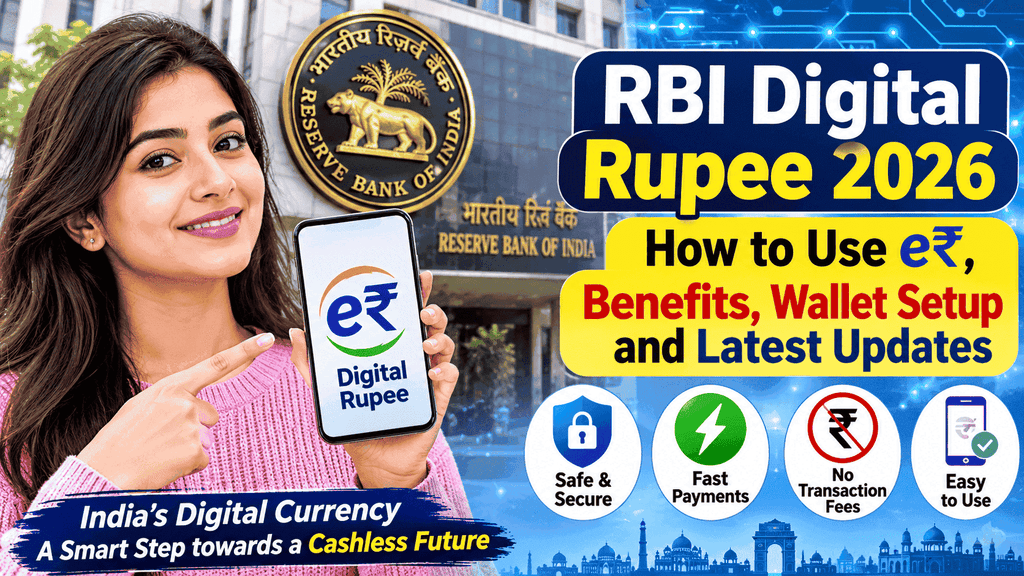
The RBI Digital Rupee 2026 is an important development in India’s digital payment system. However, it is different from UPI, cryptocurrency, and money stored in a regular bank account. Understanding these differences can help people use digital currency more confidently.
According to the RBI’s Digital Rupee FAQs updated on October 1, 2026, the Digital Rupee is currently being tested through retail and wholesale pilot programmes. Therefore, access is available through participating banks and non-bank providers rather than every financial institution. https://www.rbi.org.in/commonman/Upload/English/FAQs/PDFs/DigitalRupee09012025.pdf
This article explains what the Digital Rupee is, how its wallet works, how users can get started, its benefits, and important safety information.
What Is RBI Digital Rupee 2026?
The Digital Rupee, or e₹, is India’s Central Bank Digital Currency (CBDC). It represents the digital form of physical Indian currency.
The RBI issues the Digital Rupee. It has the same value as the physical Rupee. For example, e₹100 is equal in value to ₹100 in physical currency.
Unlike cryptocurrencies such as Bitcoin, the Digital Rupee is issued and guaranteed by India’s central bank. It is not a privately created digital asset.
The Digital Rupee is designed to provide some of the features of cash in digital form. Users can store it in an e₹ wallet, send it to another eligible wallet, and make payments to participating merchants.
The RBI’s official tagline for the Digital Rupee is “Cash, but Digital!” https://www.rbi.org.in/commonman/Upload/English/FAQs/PDFs/DigitalRupee09012025.pdf
Latest RBI Digital Rupee Updates 2026
The Digital Rupee continues to develop as part of India’s financial technology system.
The following points are important for users:
- The Digital Rupee is issued by the Reserve Bank of India.
- Retail CBDC is intended for public use, while wholesale CBDC is intended for banks and institutions.
- Participating banks and non-bank providers offer e₹ wallets.
- Users can make person-to-person (P2P) and person-to-merchant (P2M) transactions.
- Digital Rupee payments can be made through supported CBDC QR codes.
- Some e₹ apps also support scanning UPI QR codes.
- The RBI continues to explore additional use cases and features.
Important: The Digital Rupee remains in a pilot phase according to the RBI’s October 2026 FAQs. Users should check whether their bank or provider supports the service before trying to register. https://www.rbi.org.in/commonman/Upload/English/FAQs/PDFs/DigitalRupee09012025.pdf
How to Use the RBI Digital Rupee Wallet
An e₹ wallet is a mobile application that stores Digital Rupee. It works somewhat like a digital version of a physical wallet.
Eligible users can follow these general steps to get started.
Step 1: Check Your Bank’s Digital Rupee Service
First, check whether your bank or a participating non-bank provider offers an e₹ wallet.
Different providers may have different registration requirements. You should use the official application provided by your bank or service provider.
Step 2: Download the Official e₹ Wallet App
If your bank supports Digital Rupee, download its official e₹ wallet application from the Google Play Store or Apple App Store.
Avoid downloading unknown applications or clicking suspicious links that claim to provide Digital Rupee services.
Step 3: Register Your Mobile Number
Open the application and follow its registration instructions.
Depending on the provider, registration may include:
- Mobile number verification
- SIM verification
- Device authentication
- Bank account selection
- Identity verification, where required
- Setting a wallet PIN
The exact process may vary from one provider to another.
Step 4: Create Your Digital Rupee Wallet
Complete the required registration steps and set a secure wallet PIN.
Once registration is successful, the wallet should be ready for use according to the provider’s instructions.
Step 5: Add Digital Rupee to Your Wallet
Users can generally load Digital Rupee from a linked bank account or another supported payment method.
For example, if you load e₹500 into your wallet, your wallet will hold Digital Rupee worth ₹500.
Always check the transaction details before confirming the transfer.
Step 6: Send or Receive Digital Rupee
Depending on the app’s available features, you may be able to send Digital Rupee using a phone number, wallet details, or QR code.
You can also receive Digital Rupee from another eligible wallet.
Step 7: Make Merchant Payments
Participating merchants may accept Digital Rupee payments through supported QR codes.
Open the wallet application, scan the merchant’s QR code, enter the payment amount, and confirm the transaction using the required authentication method.
The available features depend on the wallet provider. https://www.rbi.org.in/commonman/Upload/English/FAQs/PDFs/DigitalRupee09012025.pdf
Benefits of RBI Digital Rupee
The Digital Rupee offers several potential benefits for digital transactions.
1. Digital Form of Indian Currency
The Digital Rupee is the digital form of physical Rupees. It allows users to hold currency digitally instead of carrying only cash.
2. RBI-Issued Currency
The Digital Rupee is issued by the Reserve Bank of India. It is not a private cryptocurrency.
This central bank backing is an important difference between e₹ and privately issued digital assets.
3. Convenient Payments
Users can send or receive the Digital Rupee through supported wallets. This can make certain payments convenient without the need to exchange physical cash.
4. Instant Settlement for CBDC Transactions
For eligible person-to-person and person-to-merchant transactions between CBDC wallets, settlement occurs instantaneously.
This feature can be useful when both parties are using compatible Digital Rupee wallets.
5. No Wallet Usage Fees
The RBI’s FAQ states that there are no charges or fees associated with using e₹ or e₹ wallets. However, users should check their provider’s terms for any other applicable services or conditions. https://www.rbi.org.in/commonman/Upload/English/FAQs/PDFs/DigitalRupee09012025.pdf
6. Payments Around the Clock
Digital Rupee can be loaded, redeemed, and transferred to or from a linked bank account 24 hours a day, seven days a week, subject to the wallet’s supported features.
7. QR Code Payments
Users may be able to pay merchants through CBDC QR codes. The RBI also notes that e₹ apps can support scanning UPI QR codes, depending on the available functionality.
Difference Between Digital Rupee and UPI
Many people believe Digital Rupee and UPI are the same. However, they are different.
| Feature | Digital Rupee (e₹) | UPI |
|---|---|---|
| Meaning | Digital form of Indian currency | Payment system |
| Issued by | Reserve Bank of India | UPI is operated through the NPCI payment system |
| Storage | e₹ wallet | Usually linked bank account |
| Purpose | Hold and transfer digital currency | Transfer money between bank accounts |
| Wallet balance | Stores Digital Rupee | Payment usually accesses bank balance |
| Transaction type | CBDC wallet-to-wallet | Bank account-to-bank account |
| Interest | No interest on e₹ wallet balance | Bank account interest depends on the bank |
The RBI explains that the Digital Rupee can serve as a store of value because users can withdraw it from a bank account and hold it separately in an e₹ wallet. UPI, on the other hand, is a payment method. https://www.rbi.org.in/commonman/Upload/English/FAQs/PDFs/DigitalRupee09012025.pdf
Is RBI Digital Rupee Safe?
The Digital Rupee is supported by the RBI’s central bank framework. However, users should still protect their wallets and devices.
Follow these safety tips:
- Download the wallet only from official app stores.
- Never share your wallet PIN or OTP.
- Do not click unknown Digital Rupee payment links.
- Check the recipient’s details before sending money.
- Keep your mobile application updated.
- Use a secure screen lock on your phone.
- Report suspicious transactions through the official wallet app or provider.
The RBI states that an e₹ wallet can be recovered using the same phone number and SIM on a new mobile device if the original device is lost. Users should follow their wallet provider’s official recovery process. https://www.rbi.org.in/commonman/Upload/English/FAQs/PDFs/DigitalRupee09012025.pdf
Who Can Use Digital Rupee in India?
Currently, users and merchants associated with participating pilot banks and non-bank providers can use the retail Digital Rupee service.
Eligible users may need a supported bank account and registered mobile number, depending on the wallet provider.
The service is not necessarily available through every bank. Therefore, check the official information from your bank before registering.
The RBI is also exploring different use cases, including programmable CBDC for certain government benefits and corporate applications.
Does Digital Rupee Pay Interest?
No. The RBI states that Digital Rupee wallet balances do not earn interest.
Digital Rupee is designed to have cash-like features. Therefore, it should not be treated as a savings deposit or an investment product.
People should understand this difference before moving money into an e₹ wallet.
Can Digital Rupee Be Used Without Internet?
The RBI has been exploring offline Digital Rupee solutions to enable transactions in locations with limited or no internet connectivity.
However, the offline feature is not universally available to all users. Its availability depends on the specific solution and provider.
Users should check their wallet application’s current features before relying on offline payments. https://www.rbi.org.in/commonman/Upload/English/FAQs/PDFs/DigitalRupee09012025.pdf
Frequently Asked Questions
1. What is RBI Digital Rupee 2026?
RBI Digital Rupee 2026 refers to India’s central bank digital currency, e₹. It is the digital form of the Indian Rupee issued by the Reserve Bank of India.
2. Isthe Digital Rupee the same as cryptocurrency?
No. Digital Rupee is issued by the RBI and represents Indian currency. Cryptocurrencies such as Bitcoin are privately created digital assets.
3. How can I download the Digital Rupee app?
You can download an official e₹ wallet app from a participating bank or non-bank provider through the Google Play Store or Apple App Store.
4. Is Digital Rupee free to use?
The RBI’s FAQs state that there are no charges or fees associated with using e₹ or e₹ wallets. Check the provider’s terms for any other applicable services.
5. Can I transfer Digital Rupee to a bank account?
Digital Rupee can be redeemed to a linked bank account through supported wallet features. Direct transfers from e₹ to an ordinary bank account or UPI VPA are not the same as wallet-to-wallet CBDC transfers.
6. Does Digital Rupee have a minimum wallet balance?
The RBI states that there is no minimum balance required to open or maintain an e₹ wallet.
7. Is Digital Rupee legal tender in India?
Yes. The RBI explains that e₹ is legal tender and is a liability of the Reserve Bank of India.
Conclusion
The RBI Digital Rupee 2026 is an important step in the development of India’s digital currency system. It allows eligible users to hold and transfer the digital form of the Indian Rupee through supported wallets.
Digital Rupee is different from UPI and cryptocurrency. It is issued by the RBI, has the same value as physical Rupees, and can be used for supported digital transactions.
Before using e₹, check whether your bank or provider participates in the pilot programme. Download only official wallet applications, protect your PIN, and verify payment details carefully.
As the Digital Rupee pilot develops, its features and availability may change. For the most accurate information, refer to the official Reserve Bank of India website.