
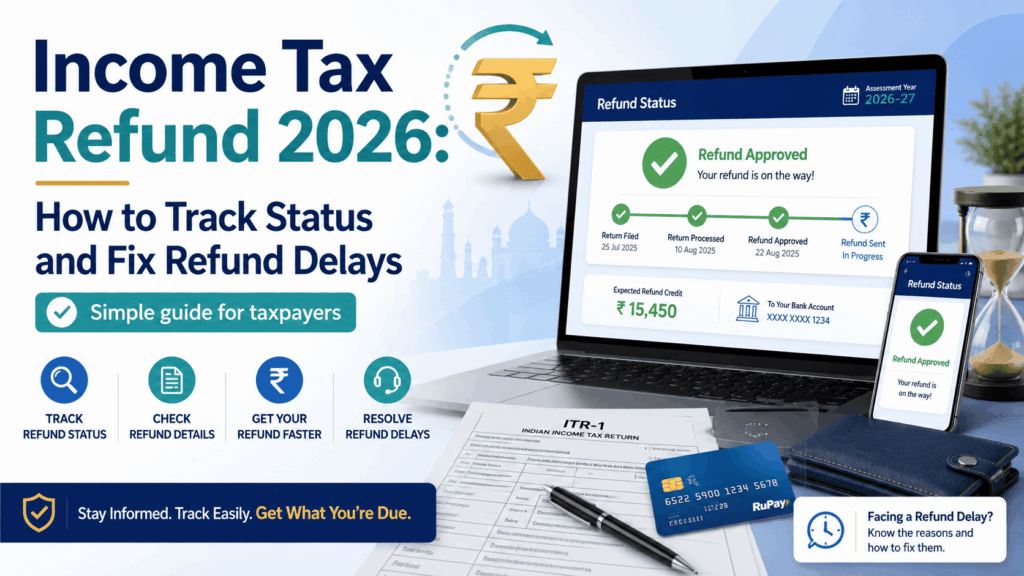
Income Tax Refund 2026 Filing an income tax return can feel like a major task completed, especially when you expect money back from the Income Tax Department. However, the experience may become frustrating when the refund does not arrive in your bank account within the expected time.
The good news is that you can track your Income Tax Refund 2026 online, understand its current status and resolve many common problems through the official Income Tax e-Filing portal.
A delayed refund does not necessarily mean that your claim has been rejected. The return may still be under processing, your bank account may need validation, or the department may have identified a mismatch in your tax information.
This guide explains how to track your income tax refund, understand common refund status messages and take the correct action when your refund is delayed or fails.
What Is an Income Tax Refund?
https://www.qaskme.com/itr-filing-2026-15-mistakes-that-can-delay-your-refund/
An income tax refund arises when the total tax paid during a financial year is higher than your final tax liability.
Your total tax payment may include:
- Tax Deducted at Source, or TDS
- Tax Collected at Source, or TCS
- Advance tax
- Self-assessment tax
- Tax deducted by your employer
- Tax deducted by a bank or another organisation
For example, suppose ₹50,000 was deducted from your income during the year, but your final tax liability was only ₹38,000. In this situation, you may be eligible for an income tax refund of ₹12,000.
However, the refund calculated while filing your return is only the amount claimed by you. The final amount is confirmed after the Income Tax Department processes your return and checks your income, deductions, tax payments and available tax credits.
How to Track Income Tax Refund 2026
You should check your refund status only through the official Income Tax e-Filing portal.
Avoid clicking on refund links received from unknown email addresses, text messages or social media accounts. Fraudulent messages may ask you to enter your PAN, bank password, card number or OTP to release a refund.
Steps to Check Your Income Tax Refund Status
Follow these steps:
- Visit the Income Tax e-Filing portal.
- Click on Login.
- Enter your PAN or registered user ID.
- Enter your password and complete the security verification.
- Open the e-File menu.
- Select Income Tax Returns.
- Click on View Filed Returns.
- Select the relevant assessment year.
- Click on View Details.
The page may show whether your return has been submitted, verified or processed. It may also display the approved refund amount, refund issue date and payment status.
The Income Tax Department provides a separate Refund Status User Manual explaining how taxpayers can check their return and refund status.
Income Tax Return Status and Refund Status Are Different
Many taxpayers confuse income tax return status with refund status. Although the two are connected, they represent different stages.
Income Tax Return Status
Your return status may show that the ITR has been:
- Submitted
- Pending for e-verification
- Successfully e-verified
- Under processing
- Processed
- Marked defective
Income Tax Refund Status
Your refund status may show that the refund has been:
- Determined
- Issued
- Sent to the bank
- Credited
- Failed
- Adjusted against an outstanding demand
A refund is normally processed only after the return has been successfully verified and reviewed by the Income Tax Department.
Common Income Tax Refund Status Messages
Understanding the status shown on the e-Filing portal can help you decide what action, if any, you need to take.
Return Submitted and Pending for e-Verification
This status means that you have filed the return, but the verification process is still incomplete.
The current time limit for e-verification or submission of ITR-V is generally 30 days from the date of filing the return. When verification is completed within that period, the original upload date is treated as the filing date.
You may be able to verify your return using:
- Aadhaar OTP
- Net banking
- Bank account EVC
- Demat account EVC
- Digital Signature Certificate
The available options may depend on your account and filing category. You can follow the department’s official e-Verification guide.
Successfully e-Verified
This status confirms that the department has successfully received your return verification.
Your return is now eligible for processing. You normally do not need to file it again. However, you should continue checking the portal for notices, tax mismatches or pending actions.
Return Under Processing
This means that the Income Tax Department is checking the information reported in your return.
During processing, the department may compare your return with records such as:
- Form 26AS
- Annual Information Statement
- Taxpayer Information Summary
- Form 16 or Form 16A
- TDS statements filed by deductors
- Advance-tax challans
- Self-assessment-tax challans
A return remaining under processing does not automatically mean that there is a problem. Some returns may require more time because of additional income sources, tax-credit reconciliation or other verification checks.
Refund Determined
This generally means that the department has processed the return and calculated a refund.
You should download the intimation issued under Section 143(1) and compare the department’s calculation with the return filed by you.
The final refund may be equal to, lower than or different from the amount originally claimed.
Refund Issued
This status means that the department has initiated the refund.
Check the bank account nominated on the e-Filing portal. Do not check only your regular salary account because you may have selected a different validated account for the refund.
The Income Tax Department’s refund guidance states that a refund usually takes around four to five weeks to reach the taxpayer’s account after e-verification, although actual processing time can vary.
Refund Failed
A failed refund means that the department attempted to transfer the amount, but the payment could not be credited to your bank account.
This may happen because:
- The bank account number is incorrect.
- The IFSC is incorrect or has changed.
- The bank account has been closed.
- The account is inactive or frozen.
- The account has not been validated.
- The account is not properly linked with PAN.
- The name in the bank account does not match the PAN record.
- The wrong account was nominated for the refund.
In such cases, you may need to correct the bank information and submit a refund reissue request.
No Demand, No Refund
This means that, according to the department’s final calculation, you neither need to pay additional tax nor receive a refund.
When you originally claimed a refund but receive this status, download the Section 143(1) intimation and compare it with your filed return.
Refund Adjusted Against Outstanding Demand
The Income Tax Department may adjust your current refund against an outstanding tax demand from an earlier assessment year.
Before accepting the demand, check:
- The relevant assessment year
- Original demand amount
- Tax payments already made
- Previous rectification requests
- Earlier processing intimations
- Assessment or appeal orders, where applicable
When you disagree with the demand, submit a response through the appropriate service on the e-Filing portal and retain supporting documents.
Why Is Your Income Tax Refund 2026 Delayed?
A delayed refund can result from several issues. The following checks can help you identify the most likely reason.
1. Your Return Has Not Been e-Verified
This should be the first detail you check.
Log in to the portal and confirm that your status says Successfully e-Verified. When it says Pending for e-Verification, complete the verification without unnecessary delay.
The return may not proceed through normal processing until valid verification is completed.
2. Your Bank Account Is Not Validated
The bank account selected for receiving the refund should be added and validated on the e-Filing portal.
Follow this path:
Login → My Profile → My Bank Account
After validation, enable the Nominate for Refund option for the correct account.
The Income Tax Department confirms that only a validated bank account can be nominated to receive an income tax refund.
You can read the official My Bank Account User Manual for detailed instructions.
3. Your Bank Account Is Not Linked With PAN
A refund may fail when the nominated bank account is not properly linked with your PAN.
The department advises taxpayers to validate and nominate bank accounts linked with PAN. Once validation is successful, the taxpayer should enable the Nominate for Refund option.
Contact your bank when the account or PAN linkage details are incorrect. After the bank updates its records, validate the account again on the e-Filing portal.
4. Your Name Does Not Match the Bank Record
Bank account validation may fail when your name in the bank’s records does not match the name associated with your PAN.
For example, your bank account may contain your complete middle name, while the PAN record may use only an initial.
Check both records carefully and request the necessary correction before attempting validation again.
5. There Is a TDS or Tax Credit Mismatch
A tax credit mismatch occurs when the TDS, TCS or tax payment claimed in your return does not match the information available in the department’s records.
This may happen when:
- An employer entered an incorrect PAN.
- A deductor did not file its TDS return.
- The deductor reported an incorrect amount.
- The TDS statement has not been updated.
- You entered incorrect challan details.
- Tax was reported under the wrong assessment year.
Compare Form 16, Form 16A and Form 26AS carefully.
When the mismatch has been caused by your employer, bank or another deductor, contact that organisation and request a correction in its TDS statement.
6. Information in AIS Does Not Match Your Return
The Annual Information Statement may contain information about:
- Salary
- Bank interest
- Dividend income
- Mutual fund transactions
- Sale of shares
- Property transactions
- Foreign remittances
- TDS and TCS
Review AIS before and after filing your return. When an entry is duplicated or incorrect, use the feedback option available in AIS.
Keep supporting records explaining why the information reported by a third party is inaccurate.
7. Your Return Has Been Marked Defective
The department may mark a return defective when important information is missing, incomplete or inconsistent.
For example, a return may be considered defective when the wrong ITR form is used or a mandatory schedule has not been completed correctly.
Do not ignore a notice issued under Section 139(9). Read the reason carefully and submit an appropriate response within the time mentioned in the notice.
8. An Outstanding Tax Demand Is Pending
An earlier tax demand may delay or reduce your Income Tax Refund 2026.
Check the Pending Actions section of the e-Filing portal. When the demand is incorrect, respond with relevant documents such as:
- Tax-payment challans
- Form 26AS
- Earlier ITR acknowledgements
- Processing intimations
- Rectification orders
- Appeal orders, where applicable
Consider professional tax advice when the demand is complex or involves a significant amount.
How to Fix a Failed Income Tax Refund
When the refund status clearly shows Refund Failed, update your bank information and submit a refund reissue request.
Steps to Submit a Refund Reissue Request
- Log in to the Income Tax e-Filing portal.
- Open the Services menu.
- Select Refund Reissue.
- Click Create Refund Reissue Request.
- Select the relevant refund record.
- Click Continue.
- Select a validated bank account.
- Complete the required verification.
- Save the request or transaction number.
The official refund reissue instructions follow this process and require the taxpayer to select the relevant refund record before continuing.
Refer to the official Refund Reissue User Manual before submitting your request.
What If the Refund Amount Is Lower Than Expected?
Download the intimation issued after processing and compare it with your filed return.
Check the following details:
- Total income
- Deductions allowed
- Taxable income
- TDS and TCS credits
- Advance tax
- Self-assessment tax
- Interest and applicable fees
- Outstanding tax demand
- Final refund amount
A lower refund may result from a tax-credit mismatch, incorrect deduction, unreported income or adjustment against an earlier demand.
When your original return contains an error and revision is still permitted, you may need to file a revised return.
When your return was correct but the department made an apparent processing error, a rectification request may be more appropriate.
Do not submit multiple returns or requests without first identifying the actual reason for the difference.
How to Raise a Grievance for a Delayed Refund
You may consider raising a grievance when:
- Your return has been processed.
- A refund has been determined.
- Your bank account is validated and nominated.
- No pending notice is visible.
- A refund reissue request has not resolved the problem.
Log in to the e-Filing portal and open the grievance service. Include the assessment year, ITR acknowledgement number, processing date, refund amount and a brief explanation of the problem.
The department allows taxpayers to check grievance status through both pre-login and post-login services.
You can refer to the official Submit Grievance User Manual.
Tips to Avoid Income Tax Refund Delays
Complete these checks before and after filing your return:
- Select the correct ITR form.
- Compare Form 16 with Form 26AS.
- Review AIS and TIS.
- Enter the correct bank account number and IFSC.
- Validate the bank account.
- Nominate the correct account for receiving the refund.
- Check tax-payment challans carefully.
- Complete e-verification within the allowed period.
- Review notices and pending actions regularly.
- Keep your registered email address and mobile number active.
- Save the ITR acknowledgement and processing intimation.
These checks cannot guarantee an immediate refund, but they can prevent many avoidable errors and payment failures.
Frequently Asked Questions About Income Tax Refund 2026
How can I check my Income Tax Refund 2026 status?
Log in to the official e-Filing portal and go to:
e-File → Income Tax Returns → View Filed Returns → View Details
How long does an income tax refund take?
According to the department’s refund status guidance, refunds usually take around four to five weeks to reach the taxpayer’s account after e-verification. The actual time may vary depending on processing and any additional checks.
Can a refund be credited to an unvalidated bank account?
Only a validated bank account can be nominated to receive an income tax refund. Check the validation status and enable the Nominate for Refund option for the correct account.
What should I do when my refund fails?
Correct the bank details, validate and nominate the account, and then submit a refund reissue request through Services → Refund Reissue.
Can an old tax demand reduce my refund?
Yes. A valid outstanding tax demand may be adjusted against the current refund. Review the demand details and supporting records before submitting your response.
Should I file another return when my refund is delayed?
Do not file another return only because the refund is delayed. First check e-verification, processing status, bank account validation, tax-credit mismatches, pending notices and the refund reissue option.
Final Thoughts
A delayed income tax refund can be inconvenient, but it does not always mean that your claim has been rejected or your money has been lost.
Start by confirming that your return has been successfully e-verified. Next, review the processing status, bank account validation and tax-credit records. When the refund has failed, submit a refund reissue request. When a notice or outstanding demand appears, respond through the correct service on the Income Tax e-Filing portal.
Most importantly, use only the official Income Tax Department website to track your Income Tax Refund 2026 or update your bank information. Never share your password, banking PIN, card details or OTP with anyone claiming that these details are required to release your refund.